Forex can sound confusing when you’re just getting started. One minute you’re learning about currency pairs, and the next you’re hearing about pips, lots, spreads and leverage. It can all feel like a lot to take in.
So, what is forex trading for beginners? Let’s keep it simple.
Forex trading means buying one currency while selling another, with the aim of making a profit from changes in their exchange rate. Think about exchanging dollars for euros before a holiday. Forex trading works on a similar idea, but instead of exchanging money for a trip, traders take positions based on how they expect one currency to move against another.
These combinations are called currency pairs. For example, if EUR/USD is trading at 1.1000, one euro is worth $1.10.
What Is Forex Trading?
Forex is short for foreign exchange. It’s the global market where people and institutions trade currencies against each other. You might also see it called FX, which is simply another name for the same market.
When you trade forex, you’re taking a position on whether one currency will gain or lose value compared with another.
Currencies are always quoted in pairs. Take EUR/USD as an example. EUR is the base currency, while USD is the quote currency. If EUR/USD is trading at 1.1000, it means one euro is worth 1.10 U.S. dollars. That’s the exchange rate.
Here’s something beginners often overlook: buying EUR/USD doesn’t just mean buying euros. It generally means you expect the euro to strengthen against the U.S. dollar. Selling EUR/USD means you expect the euro to weaken against the dollar.
In other words, you’re comparing the value of two currencies. Even if the euro gains value, EUR/USD could still fall if the dollar strengthens more.
How Does Forex Trading Work?
So, how does forex trading work when you actually place a trade?
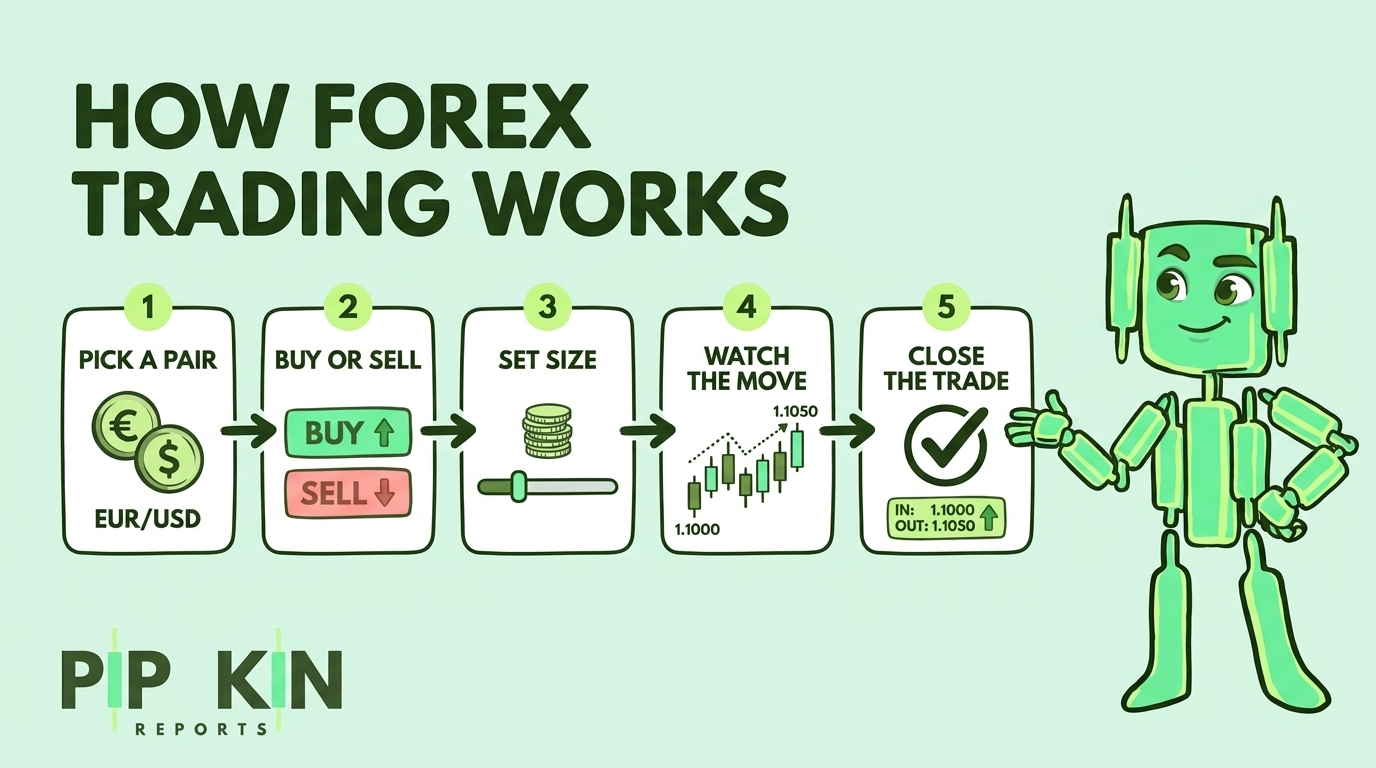
The basic process is pretty straightforward. You choose a currency pair, decide which direction you think it will move, select your trade size and open a position. You then close the trade later, based on your strategy or changing market conditions.
Here’s how that works in practice:
- Choose a currency pair. For example, EUR/USD, which tracks the euro against the U.S. dollar.
- Decide whether to buy or sell. Buying generally means you expect the euro to strengthen against the dollar. Selling means you expect it to weaken.
- Choose your trade size. This determines how much currency exposure you’re taking on. We’ll cover how traders measure position size in the next section.
- Watch the exchange rate move. Suppose EUR/USD rises from 1.1000 to 1.1050. That price change affects your profit or loss, depending on whether you bought or sold.
- Close the trade. The difference between your entry and exit prices determines your result before trading costs.
These numbers are hypothetical, but they help explain the forex trading basics. You choose a pair, decide on a direction, select a position size and eventually close the trade.
The same price movement can produce very different results. If you bought EUR/USD at 1.1000 and it rose to 1.1050, the move would work in your favor. If you sold at 1.1000, the same move would work against you.
Forex Trading Basics: Pips, Lots, Spreads and Leverage
You’ll come across four terms in almost every beginner’s forex guide: pips, lots, spreads and leverage.
Let’s break down what each one means and why it matters when you’re learning how to trade forex.
What Is a Pip in Forex?
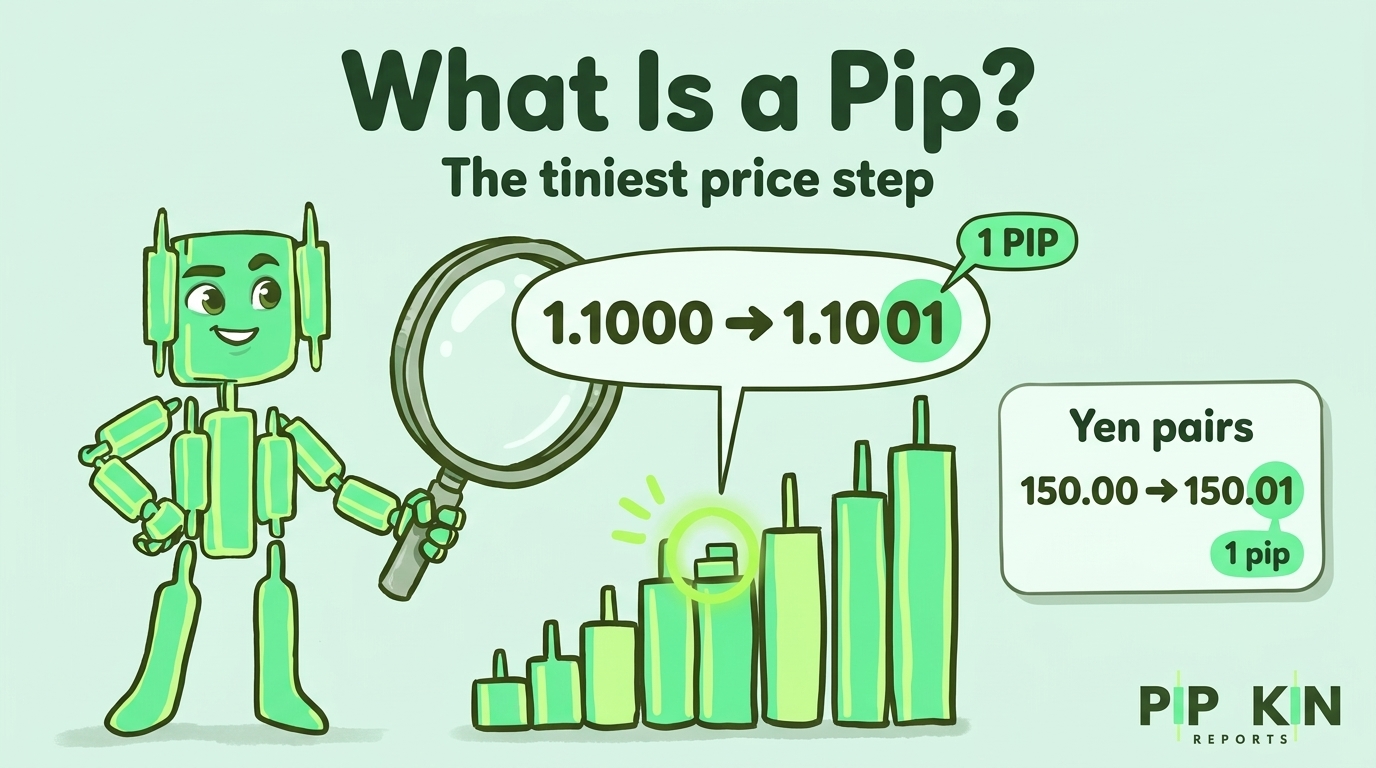
A pip is a standard unit used to measure small changes in a currency pair’s price.
For most currency pairs, a move from 1.1000 to 1.1001 represents one pip. That’s a tiny change in the exchange rate, but its financial impact depends on how large your position is.
Japanese yen pairs generally use a different decimal convention. For these pairs, a pip is usually measured at the second decimal place rather than the fourth.
What Is a Lot in Forex?
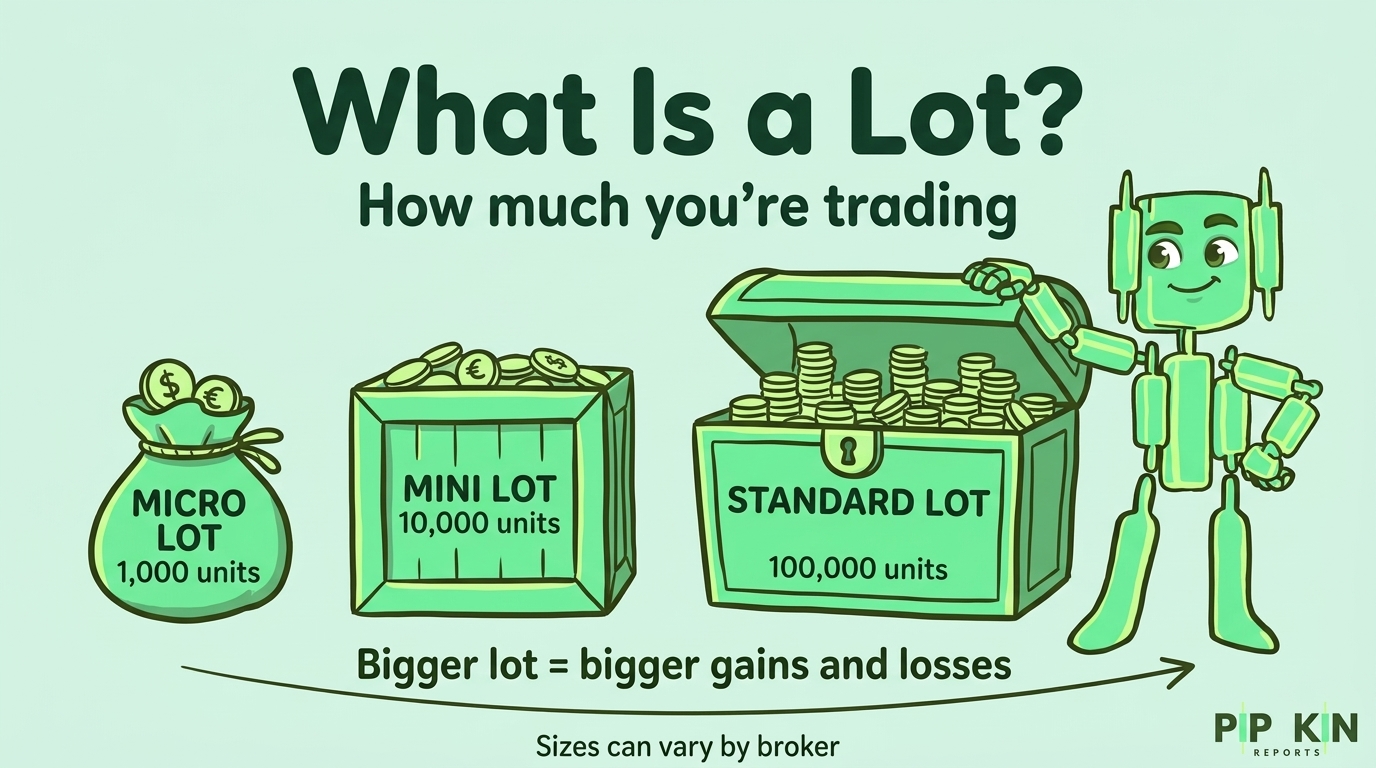
A lot tells you how much currency you’re trading. The size of your position matters because it affects how much you could gain or lose when the exchange rate moves.
The common forex lot sizes are:
- Standard lot: 100,000 currency units
- Mini lot: 10,000 currency units
- Micro lot: 1,000 currency units
These are standard lot categories, but the exact trading conditions can vary between brokers and account types. Check the contract details before opening a position.
What Is a Forex Spread?
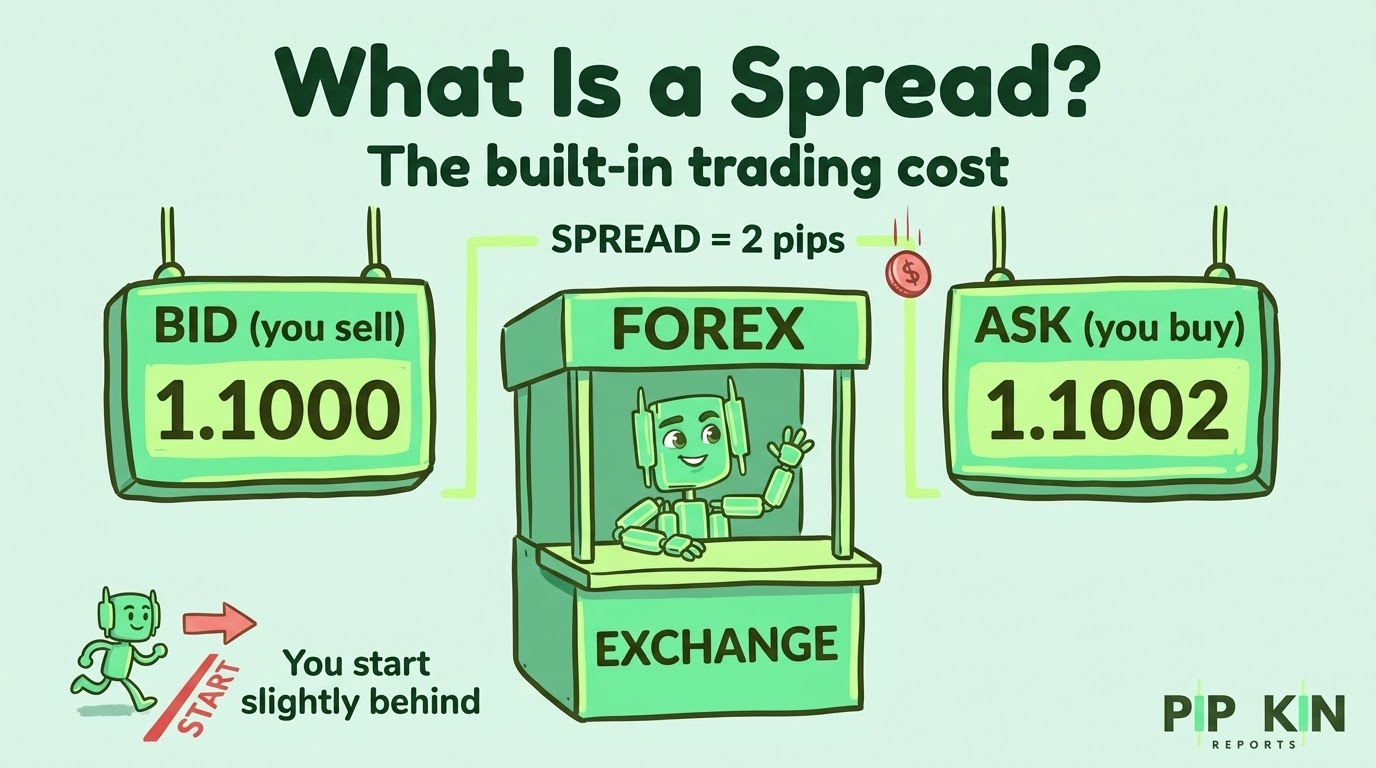
The spread is the difference between the bid price and the ask price.
The bid is the price at which you can sell, while the ask is the price at which you can buy.
For example, if EUR/USD has a bid price of 1.1000 and an ask price of 1.1002, the spread is two pips.
Why does this matter? Because the spread is one of the costs you need to account for when trading. When you open a position, the difference between the buying and selling prices can put you slightly behind from the start.
What Is Leverage in Forex?
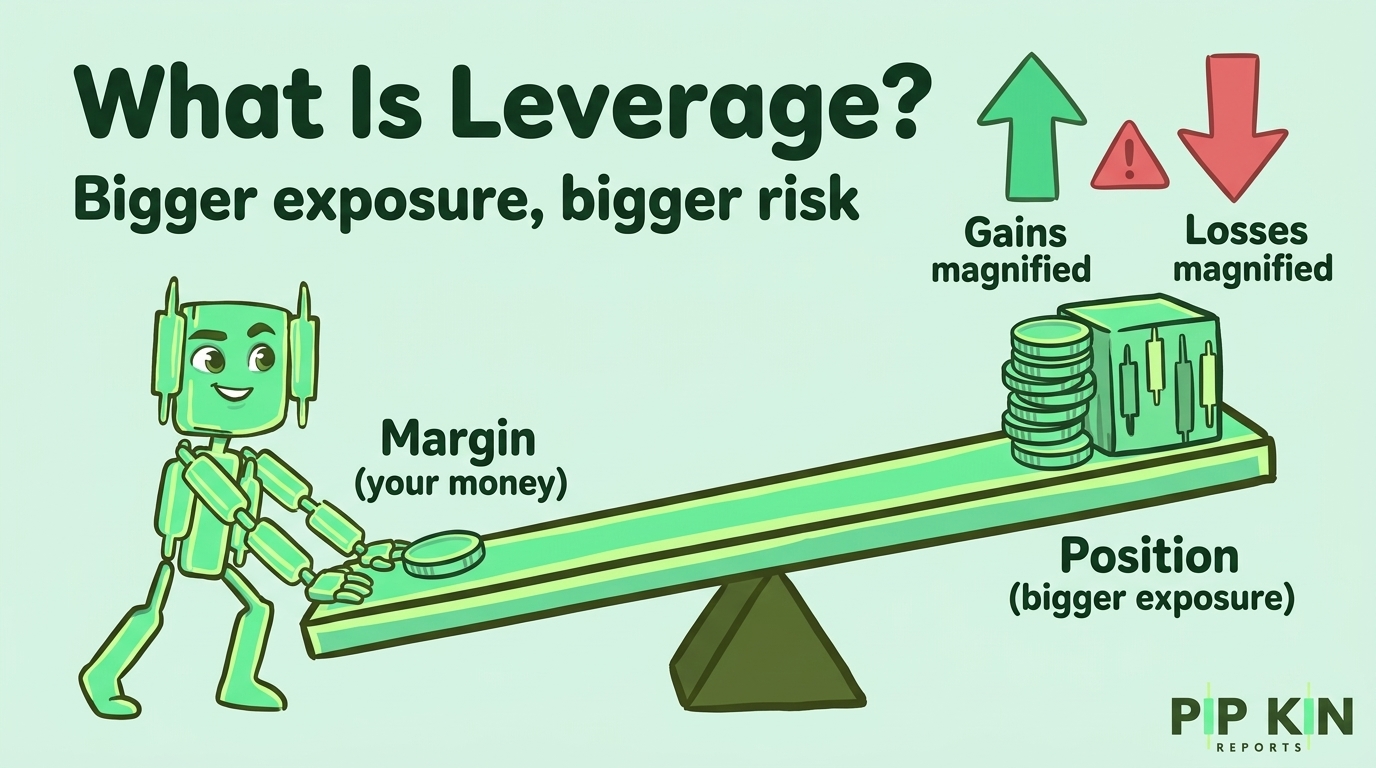
Leverage allows you to control a larger position with less money than you would otherwise need.
For example, a broker might let you open a position worth more than the money you’ve deposited. The amount of your own capital required to support that position is known as margin.
However, there’s an important catch. Forex leverage increases your exposure to the market, which means it can magnify both gains and losses. Even a relatively small price movement can have a significant effect on your account when you’re trading with leverage.
In simple terms, pips measure price movements, lots describe position size, spreads are a trading cost, and leverage allows you to take on greater market exposure while increasing your potential losses.
What Are the Major Forex Currency Pairs?
The major forex currency pairs are among the most widely traded currency combinations in the market. There are seven commonly recognized majors:
- EUR/USD
- USD/JPY
- GBP/USD
- USD/CHF
- AUD/USD
- USD/CAD
- NZD/USD
The U.S. dollar appears in every major pair.
You’ll also come across minor currency pairs, which don’t include the U.S. dollar. Examples include EUR/GBP, EUR/JPY and GBP/JPY.
Then there are exotic currency pairs, which combine a major currency with a currency from a smaller or emerging market.
Not all currency pairs behave the same way. They can differ in liquidity, spreads and how much their prices move.
There’s no single pair that every beginner should trade. The right choice depends on your strategy, trading costs, market conditions and how much risk you’re prepared to take.
The important thing is to understand the pair you’re trading rather than assuming that all currencies move in the same way.
Who Trades Forex and Why?
Forex isn’t just a market for individual traders sitting in front of their screens. It brings together a wide range of participants, including central banks, commercial banks, financial institutions, multinational companies, investment funds, hedge funds and retail traders.
Each participant has different reasons for trading currencies.
A company might need to exchange money to pay an overseas supplier. Another business may use forex to hedge currency risk, which means protecting itself against unfavorable exchange-rate movements.
Investment funds may trade currencies as part of their investment strategies, while some market participants aim to profit from changes in exchange rates.
Retail traders, meanwhile, make up just one part of this much larger market. They’re trading alongside institutions and businesses that may have very different goals, resources and financial needs.
What Are the Biggest Forex Risks for Beginners?
Understanding how forex trading works is only half the picture. You also need to know what can go wrong.
Forex trading involves financial risk, and losses are possible even when you understand the market. Here are some of the main forex trading risks beginners should know about.
- Leverage risk. Leverage lets you control a larger position with less capital, but it can also make losses add up quickly. Depending on your broker, account type and jurisdiction, losses may exceed your initial deposit.
- Market volatility. Currency prices can move sharply following interest-rate decisions, inflation reports, employment data, central-bank announcements and geopolitical developments. A trade that looks promising can quickly move against you.
- Trading costs. Spreads, commissions and overnight financing charges, sometimes called swap fees, can eat into your results. These costs matter even when the market moves in your expected direction.
- Broker and counterparty risk. Before opening an account, check who operates the brokerage, which regulator oversees it, where it is authorized to operate, and what fees, withdrawal rules and customer protections apply. Regulation and protections vary by country.
- Forex scams. Be cautious of anyone promising guaranteed profits, risk-free trading or a secret system that supposedly makes consistent money. Social media pitches promising quick wealth through forex deserve particular scrutiny.
The point isn’t to suggest that everyone should or shouldn’t trade forex. It’s to understand the risks before putting your money on the line.
How to Start Forex Trading as a Beginner
If you’re still wondering how to start forex trading, take your time. You don’t need to rush into opening a live account just because you’ve learned what a currency pair is.
Here’s a practical way to get started.
- Learn the basics first. Make sure you understand currency pairs, pips, lots, spreads, leverage and margin. It’s also worth learning about basic order types and stop-loss orders, which can help you manage how and when a trade closes.
- Research your broker. Don’t choose a forex broker based on advertising alone. Check its regulatory status, operating jurisdiction, fees, spreads, withdrawal policies, available markets, risk disclosures and account requirements. Learning how to choose a forex broker is an important part of getting started.
- Practice with a demo account. A forex demo account lets you open and close trades using virtual money. You can get familiar with the trading platform, test how orders work and see how currency prices move without risking real money. Just remember that demo trading doesn’t fully replicate the emotions or financial consequences of trading with your own cash.
- Set your risk rules before trading live. Decide how much you’re prepared to risk, understand how position size affects potential losses, and think about where you would exit a losing trade. You should also know how leverage affects your exposure before using it.
Learning the mechanics is one thing. Putting money into the market is another. Give yourself time to understand both.
The Bottom Line
Forex trading is pretty simple to define: you’re trading one currency against another and trying to profit from changes in their exchange rate.
The learning curve comes from understanding how currency pairs work, what affects exchange rates, how position sizes influence your results and how trading costs and leverage affect your money.
You don’t need to master everything in one day. Start with the basics, get comfortable with how currency pairs are quoted, and learn how to read forex currency pairs before placing your first trade.