Crypto has been around long enough to be mocked, dismissed, attacked, proclaimed dead, and eventually absorbed into the financial system that it was supposed to challenge. What started as a fringe project, dismissed as “fake internet money” and listed on questionable forums, has turned into an institutional asset category. BlackRock and Fidelity are household names in crypto discussions, and Bitcoin ETFs are now mainstream.
But even in the face of this mainstream acceptance, there is one basic truth: unless the spot asset is owned, the revolution is not owned.
In 2026, the digital assets market is more controlled, regulated, and faster than before. In the United States, the GENIUS Act, MiCA in Europe, and reporting on DAC8 in the EU has introduced transparency into the system. Price signals flash continuously on dashboards and social feeds, and new financial products are offering convenience and exposure without custody. Under this noise, a true sovereign ownership can only be attained through spot trading crypto.
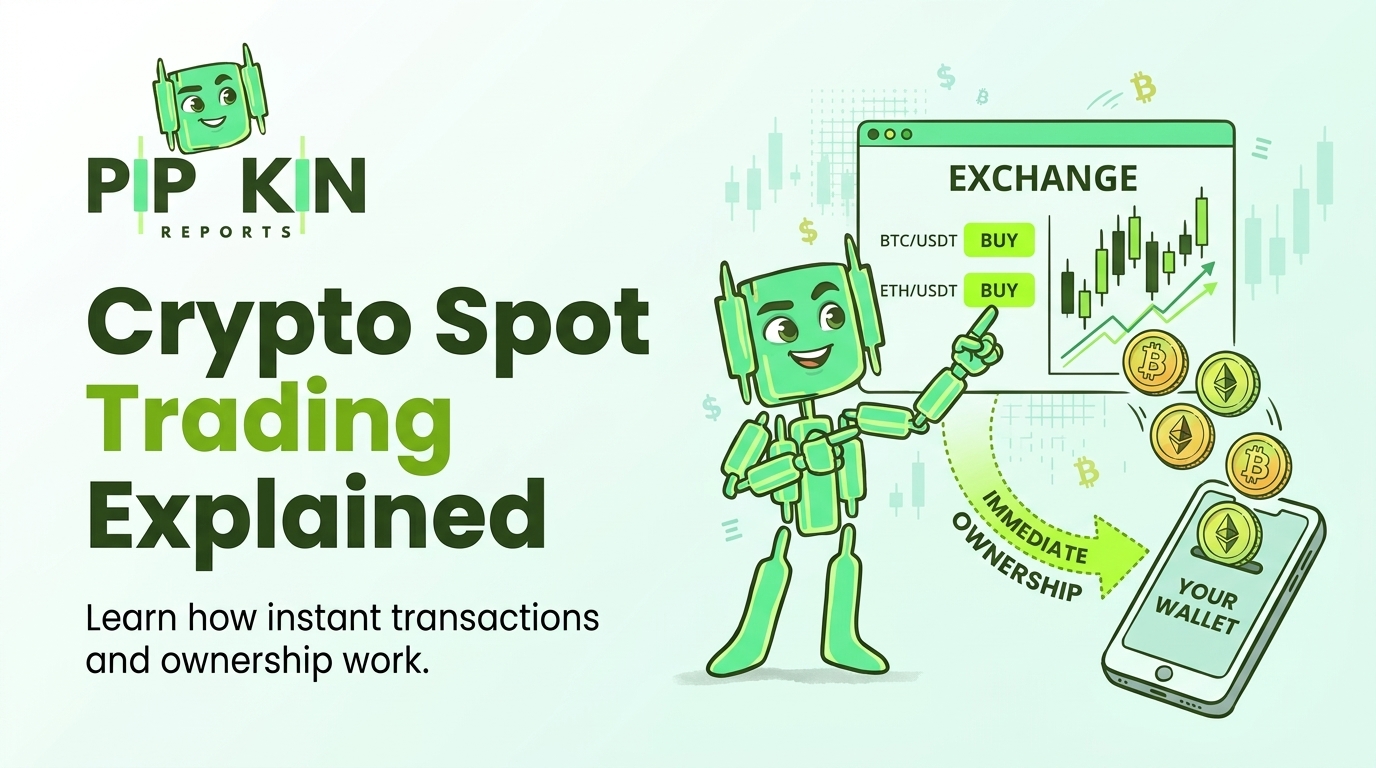
What is Spot Trading Crypto Actually Means
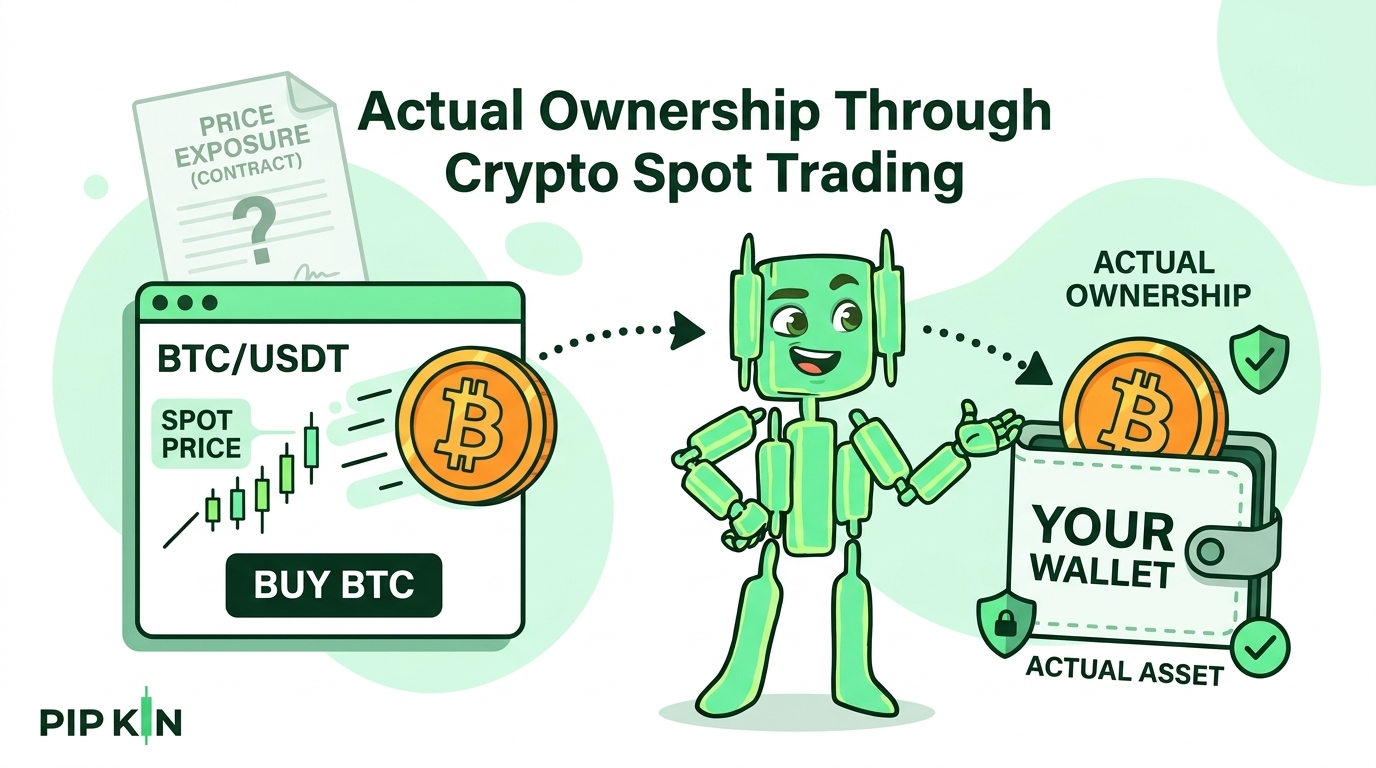
Most definitions narrow down what is spot trading in crypto to “immediate settlement” or to “pay now, receive asset now.” This is technically accurate, but lacks the practical truth: spot trading is the act of purchasing the actual asset. Period. The coins are sent straight to the wallet of the trader at the market price, which is the “spot” price.
In 2026, the spot market is the backbone of a $20 trillion stablecoin economy. It is where actual liquidity exists and onto which all other derivative and exposure products end up settling.
How to Spot Trade Crypto in 2026
There is a shift in the mechanisms of how to purchase cryptocurrency. At some point, the issue was how to bridge fiat and crypto. But today in DeFi ecosystem, there are on-ramps everywhere, although they are all controlled and regulated.
The Death of the “Off-Grid” Cash Buy
Issues such as where can I buy bitcoins with cash are now complicated. Days of anonymous cash purchases are past. Bitcoin ATMs and P2P desks are treated as branches of the bank under the GENIUS act. Identity checking, such as biometrics, is a prerequisite to processed transactions.
Cash is still a legitimate method to obtain crypto, but privacy is no longer assured. Any individual hoping to make money with bitcoin should be willing to be transparent and compliant.
Hunting the Best Exchange
The best way to buy crypto is not related to marketing or advertisements, it is connected to trust, liquidity, and cost-effectiveness.
- Binance and Kraken: Not without a purpose. The lowest spot trading fees crypto is usually around 0.1% which is important to high volume traders.
- Robinhood: Easy to use with casual investors and set it and forget it, but can be unprofitable due to spreads.
Spot Trading Crypto App
The 2026 game-changer is a spot trading crypto app which supports Account Abstraction. This technology prevents forgetting of seed phrases and retains complete ownership. Self-custody is now as natural as a typical banking app, and therefore required by anyone aiming to sell bitcoin or carry out complex spot trading strategies.
How Spot Trading Works
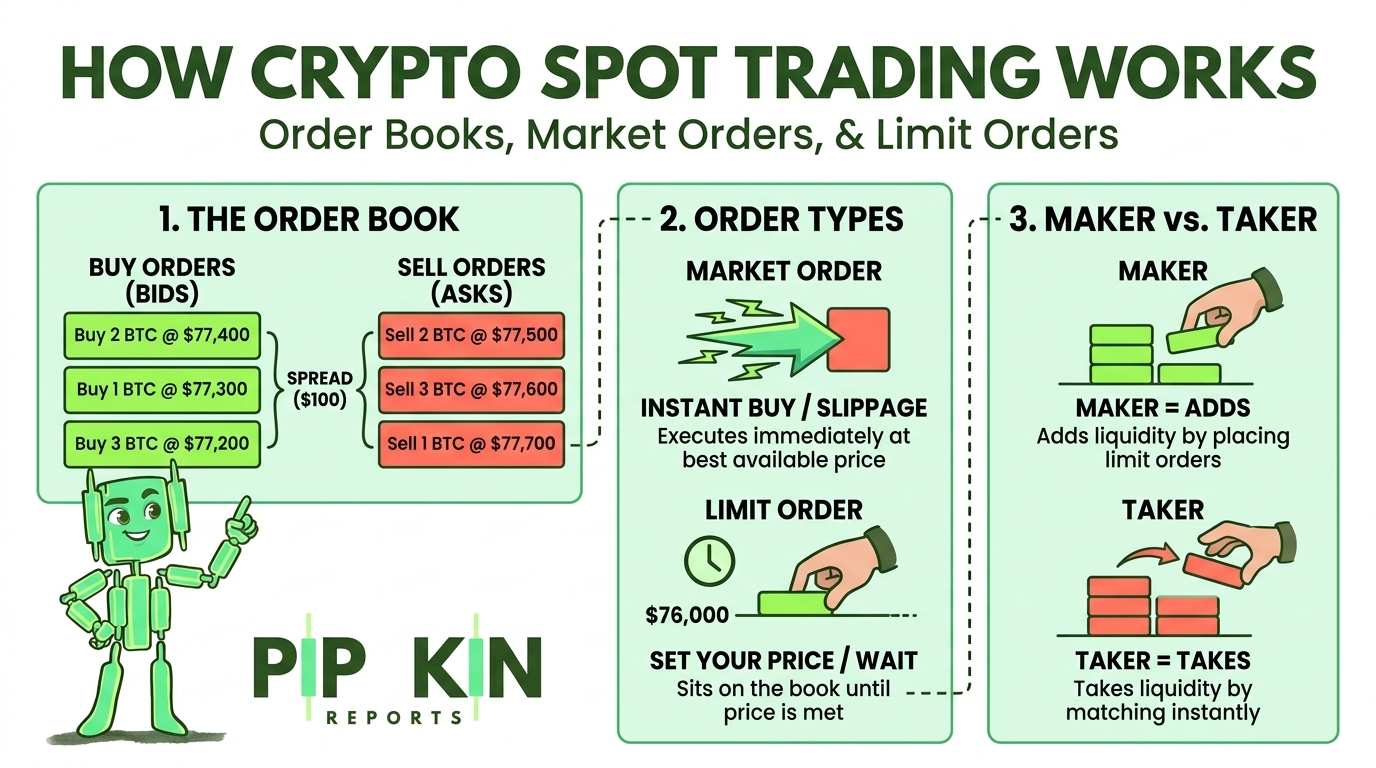
The majority believes that spot trading is simply pressing a button and receiving coins. That’s the user interface. However, to trade like a pro you must have an insight into Market Microstructure.
In 2026, the spot market isn’t a single entity; it’s a massive, high-speed game of “Matching.”
The Central Limit Order Book (CLOB)
When you trade on a leading exchange you are dealing with an Order Book.
- The Bids (Green): This is the group of buyers. They are screaming, I would like to buy 2 BTC at $77,400!
- The Asks (Red): These are the sellers. They are screaming, “I can sell my 2 BTC to 77,500 dollars only!
- The Spread: The difference between that $77,500 and $77,400. That is the transaction fee that the market will impose on you because of liquidity.
How Your Order Gets Executed
You can place order in spot market in two different ways:
1- Market Orders (The “I Want it Now” Button):
You are not concerned about the price; you want the coins now. You “cross the spread” and make a purchase at the lowest price (the Ask).
Large amounts of market orders are dangerous in 2026. When you attempt to place a market order to purchase $1M of an altcoin, you will be subjected to Slippage, the experience of accidentally buying out all of the order book at successively higher prices.
2- Limit Orders (The “Patient Hunter” Method):
You specify a certain price. I will not purchase Bitcoin until it reaches $76,000. Your order sits in the book. You are a Maker; you are liquidating the market.
The 2026 Perk: Most exchanges offer you a discount on charges (or even pay you) when you are a Maker, as you are assisting the exchange to remain in liquid condition.
The “Spot” in Spot Trading
In the old world (T+2), a stock trade took two days to actually settle. In 2026, crypto settlement is Atomic and Instant. When your order matches, the internal ledger of the exchange transfers the crypto that is typically in your pocket, usually USDT, to the pocket of the seller, and the BTC in theirs to yours. That is why it is referred to as “Spot”, delivery is made on the spot.
Liquidity
In 2026, Liquidity Providers (LPs) primarily high-frequency trading firms are the ones doing the order books a service. They apply complicated algorithms to ensure that you have someone to sell or purchase from, at all times.
- A “Thin” Market: When you are dealing with a low-cap meme coin, the order book is thin. A single buy order worth $50000 could cause the price to rise 20%.
- A “Deep” Market: Bitcoin in 2026 is deep enough that you can drop $100M into the spot market and hardly move the price an inch. This is the place where the professionals play.
In short, avoid being a market order junkie. Limit Orders are used by professionals so that they can place their positions at the price they desire and not at the price the market dictates.
Benefits and Risks of Crypto Spot Trading
Spot trading involves strategic involvement rather than pursuing headline profits.
Benefits
Spot trading crypto has certain advantages over leverage and other trading. Let us see them:
- No Liquidation: A highly important benefit of spot trading crypto is that there is no liquidation of positions. Spot traders have full control, unlike leverage trading crypto which puts assets at the mercy of exchange-imposed closures. Bitcoin may fall by a factor of four in the overnight and the coins would not be moved. Time, instead of margin call, becomes the main instrument of managing volatility. It is as though you are holding a gold bar in your hand, regardless of the price changing, you are not in danger of losing it, growth in price will be adding value to your holding whereas declines in price will be decreasing the value of the coin you are holding. Interesting thing though is that, you are not making any profit or loss unless you sell what you have.
- The Passive Income Engine: Spots holders are digital landlords. With Ethereum (ETH) or Solana (SOL) in a spot wallet and stake holdings, you do not simply watch the price rise and fall, you receive some rent, we call it staking rewards, which is approximately 2.7% -3.7% per year. The owners of ETFs are just beneficiaries of price changes- they do not get yield. On the other hand, staked spot holdings earn you an income on staking in addition to the coin price increase, and this is a better method of building wealth over time.
- Use of Coins in Other Opportunities: Holding the actual coin will allow you to use it in other opportunities- such as lending, providing liquidity or being involved in NFT marketplaces. In contrast to ETFs or futures, spot holdings can communicate with the rest of the crypto ecosystem, which creates various methods of generating or accumulating wealth.
- Reduced Counterparty Risk: In spot trading you are not subjected to liquidations that are imposed by the exchange. You have the asset in your custody and therefore no one can close your position against your will. This minimizes structural risk and gives full control of your portfolio.
Risks
Spot trading crypto comes with the following risks that every trader should understand.
- Price Volatility: Even so-called blue-chip participants in the world of cryptocurrencies are very volatile. As an example, in October 2026, the two cryptocurrencies Bitcoin and Ethereum dropped by 7.3% and 16%, respectively. It means that owning even the popular coins is risky here. Traders should be ready to experience abrupt changes in prices and also realize that they can make short term losses.
- Regulatory Compliance: Cryptocurrency trading ceases to be a free-for-all setup. Regulations, such as MiCA in Europe and DAC8 reporting, imply that all trades are monitored. Trades are notified straight to the authorities, and thus, it is not realistic to sell Bitcoin without thought of taxes. Also, failure to follow compliance may result in legal or fines.
- Realized vs. Unrealized Gains: Spot trading gains or losses are not real until the time when coins are sold. The market fluctuations can put your holdings on paper as an enormous profit or loss, but it will not become a reality until a sale occurs. These unrealized fluctuations are very important to be handled through patience and timing.
- Discipline Required: Unlike leveraged trading, spot trading doesn’t force liquidation—but it does demand discipline. It requires holding in times of volatility, making decisions to purchase or sell, and adhering to a plan to protect the capital and make maximum returns. Even the simple possession of the physical coins may cause lost chances or panic selling without self-control.
- Limited Hedge Options: Spot trading is a case of ownership but not necessarily hedging against a market decline. This is in contrast to futures or options, in which the trader is automatically offset by their losses, and as such, they have to employ other techniques such as diversification or staking to hedge.
- Platform Risk: keeping coins on an exchange exposes you to that exchange’s security. The reported Binance hack in October 2026 is the latest reminder.
Crypto Spot Trading vs Futures Trading vs Margin Trading
Spot trading is very different compared to exposure only trading. It is important to value the difference of spot trading crypto vs buying crypto.
Spot Ownership vs ETFs
Bitcoin ETFs are convenient but “caged” assets. They would simply trade within the market hours whereas, spot crypto market operates 24/7/365. It means that spot traders can respond immediately to what is happening in the world with ETF holders having to wait.
The Leverage Trap
Novices tend to attract towards crypto spot trading leverage and take up a loan to be more active. However, here, positions can be washed out within seconds with sudden price spikes or wicks. In short, leverage is gambling, and spot trading is building.
| Feature | Spot Trading | Crypto ETFs | Margin Trading | Futures Trading |
| What you own | Actual crypto asset | ETF shares (no real crypto) | Borrowed position | Contract, not the asset |
| Ownership | Full ownership | Indirect exposure | Temporary | No ownership |
| Leverage | ❌ No | ❌ No | ✅ Yes | ✅ Yes |
| Liquidation risk | ❌ None | ❌ None | ⚠️ High | ⚠️ Very high |
| Settlement | Instant (on the spot) | T+1 / market hours | Instant but conditional | Contract-based |
| Market hours | 24/7/365 | Stock market hours | 24/7 | 24/7 |
| Fees | Low trading fees | Management + tracking fees | Interest + fees | Funding + fees |
| Can stake / earn yield | ✅ Yes | ❌ No | ❌ No | ❌ No |
| Best for | Long-term holders, disciplined traders | Passive investors | Short-term speculation | Advanced traders |
| Risk level | Moderate | Low–Moderate | High | Very High |
| Tax simplicity | Medium | Easy | Complex | Complex |
| Halal compliance | ✅ Generally halal | ⚠️ Depends | ❌ Usually not | ❌ Not halal |
Choosing the Best Exchange for Spot Trading Crypto
During our early days, we used to select exchanges by the one that had the coolest website. Today, when you are not staring at Liquidity, Proof of Reserves, and Account Abstraction, you are just inviting a headache.
The “Big Three” of 2026
The majority of professional spot traders spread their capital on three types of platforms according to their needs:
1- The Liquidity King: Binance If you are moving serious volume, you go where the depth is. Binance remains the best choice for lowest spot trading fees crypto has to offer (standard 0.1%, often lower when trading with BNB).
Security note: reports say a roughly $6.3 billion hack hit Binance on 29 October 2026, and Bitcoin hit its monthly low the next day. Before depositing, check Binance’s latest statements on user funds, withdrawals, and reserves. Binance is also not available to most US users, who are limited to Binance.US.
2- The Regulatory Safe Haven: Coinbase & Kraken For those of us in the US or Europe dealing with MiCA and the GENIUS Act, these are the “Adults in the Room.”
Coinbase is the gold standard for compliance and issues Form 1099-DA. It relies on SEC-audited financial statements rather than Merkle-tree proof of reserves.
Kraken is the veteran’s favorite for security. o It was founded in 2011, opened its exchange in 2013, and pioneered public proof of reserves. No client funds have been lost to a Kraken hack.
3- The Altcoin Gateway: MEXC & Gate.io If you’re hunting for the next big altcoin before it hits the mainstream, these exchanges list assets faster than anyone else.
The only thing to watch is to get liquidity in this market! It is thin in the sense that a modest sell order can cause the price to fall.
What to Look for in a Best Spot App
Don’t just download the first thing you see in the App Store. A professional-grade spot trading crypto app must have these three things:
- Account Abstraction (Smart Wallets): We’re officially done with 24-word seed phrases. Top apps now use “Social Recovery” and biometrics. If you lose your phone, you don’t lose your life savings.
- Proof of Reserves (PoR): In 2026, we don’t “trust,” we verify. Your exchange should provide a real-time, Merkle-tree-verified audit showing they actually hold your coins 1:1.
- Native Staking Integration: If you’re trading spot ETH or SOL, the app should allow you to “one-click stake.” Don’t let your assets sit idle; make them earn that 3% yield while you wait for the next price pump.
Using a centralized exchange (CEX) like Coinbase is like putting your money in a high-security bank. It’s convenient and insured. Using a decentralized exchange (DEX) with a self-custody wallet is like having a private vault in your basement. You have total control, but if you lose the key, nobody can help you.
To learn more about the difference between the two exchanges, read our guide on DEX vs CEX.
Before you deposit a single satoshi, ask yourself:
- Is this exchange licensed in my region (to avoid a sudden “freeze”)?
- Are the fees low enough that I’m not losing 1% of every trade?
- Does the app support Account Abstraction for easy recovery?
- What is this exchange’s recent security record, and how does it prove it holds client assets?
Professional Crypto Spot Trading Strategies

In 2026, trying to trade on the basis of vibes and social media influencers is basically giving your money to the high-frequency bots.
Winning in the current market does not have anything to do with being a genius, it has to do with understanding that human instincts are sometimes a liability.
Automated Spot Trading
Nowadays, AI is not telling traders what they should purchase. Its aim is to make sure that trading rules are respected. In 2026, AI agents are used as layers of execution, disciplining, minimizing errors, and automating the routine.
- The “Rebalance” Bot: In this approach, the bot agent keeps track of spot ratios at all times. To illustrate, when ETH increases by 20%, and tokenized T-bills are unchanged, the agent will automatically hedge the gains and rebalance the portfolio. This eliminates the “but what happens when it goes higher.” Doubt that frequently kills retail accounts.
- Intelligent Trailing Stops: In this procedure, wick-hunting bots usually target intelligent trailing stops. The AI agents are used to handle dynamic exits, which are automatic and controlled by real-time volatility and act as a “sober second thought” during sudden market changes, even at 2 AM.
Using On-Chain Data Over Everything
The 2026 market is flooded with spot trading crypto signals, many of which are traps designed as exit liquidity for whales. Traders should ignore the majority and focus only on signals derived from the ledger itself and find out the best crypto for spot trading themselves.
For example:
- Whale Shadowing: When BTC move onto exchanges in large volumes, like $500M spotted on Arkham or Whale Alert, then that generally indicates that the whales are about to sell. This may cause abrupt negative pressure on the market. Whenever such inflows happen, the traders are advised to tighten stop-losses or limit exposure, irrespective of bullish news or hype.
- Exchange Outflows: As money moves out of exchanges to cold storage, the quantity of marketable supply is reduced. This is what the Supply Shock strategy is all about: the tighter the supply, the higher the prices can be. It is essential to monitor the amount of exchange reserves in real-time, declining reserves might be a sign of a buying opportunity, despite what the media is discussing about fear or panic.
- Stablecoin Inflows: Observing big deposits of stablecoins is the first step towards predicting huge purchase behavior. To illustrate, when $2B in USDT enters an exchange, it can be a sign that buyers are willing to put money to work. Placing a bet in market ahead of these inflows enables traders to have an upper hand by getting into the market earlier than the market movement.
To put it briefly, trading without on-chain information is like playing poker with eyes shut. You could get a hand lucky, but you might lose your stack to the one who can see all the chips and moves of the other players. Here, on-chain data provides you those “eyes” on the table.
The Strategist’s Rulebook
- System over Sentiment: It is necessary to only make trades based on the pre-defined strategy. Avoid impulsive decisions.
- Watch the Smart Money: Don’t trust what whales say–watch where they really transfer their money.
- Respect the Spread: Slippage is a silent killer. Place limit orders, or risk unnecessary losses.
Is Spot Trading Crypto Halal?
Yes, crypto Shariah-compliant advisors like Wahed and IFG confirm that spot trading of crypto is halal:
- It entails actual exchange of assets (Asl).
- There is no Riba (interest). Spot purchases are not speculations done through borrowing.
- Futures or high-leverage trading crosses into prohibited gambling territory.
Spot trading is ethical ownership within the Islamic finance principles.
Summing Up
Spot trading in crypto simply means buying the actual asset at the current price and owning it instantly, without leverage, loans, or liquidation risk.
In 2026, the spot market is the foundation of the crypto economy. Buying crypto today is easier but fully regulated, cash purchases are tracked, and choosing the right exchange comes down to liquidity, fees, and trust.
Crypto spot trading offers control, ownership, staking income, and reduced counterparty risk, but it also demands discipline, patience, and respect for volatility and regulation. Compared to futures, margin, or ETFs, spot trading is halal and about building, not gambling.
The quick answer to what is spot trading is that if you want true exposure, real ownership, and a sustainable way to trade crypto in 2026, spot trading is the core path.