Money runs the world, yet many people still feel locked out. Banks control access, governments set the rules that follow, and middlemen take fees, so the whole process often feels slow and frustrating. But should money really feel like such a closed and rigid system?
Now imagine a system that works more like the internet. The internet is always on, it is open to everyone, and it asks no one for permission, so access is constant for anyone who chooses to join. Wouldn’t finance become far more inclusive if it worked in the same way? That system is Decentralized Finance, which most people call DeFi.
DeFi is not a passing trend because it has grown to hold billions in value. That growth matters since value attracts builders who in turn create useful tools. Therefore, just as email replaced letters and streaming replaced DVDs, DeFi aims to upgrade the way money moves.
So, the questions become simple. What is DeFi? How does it work? Where might it help and where might it fail? Most importantly, how could it shape everyday life for ordinary people?
Definition of DeFi
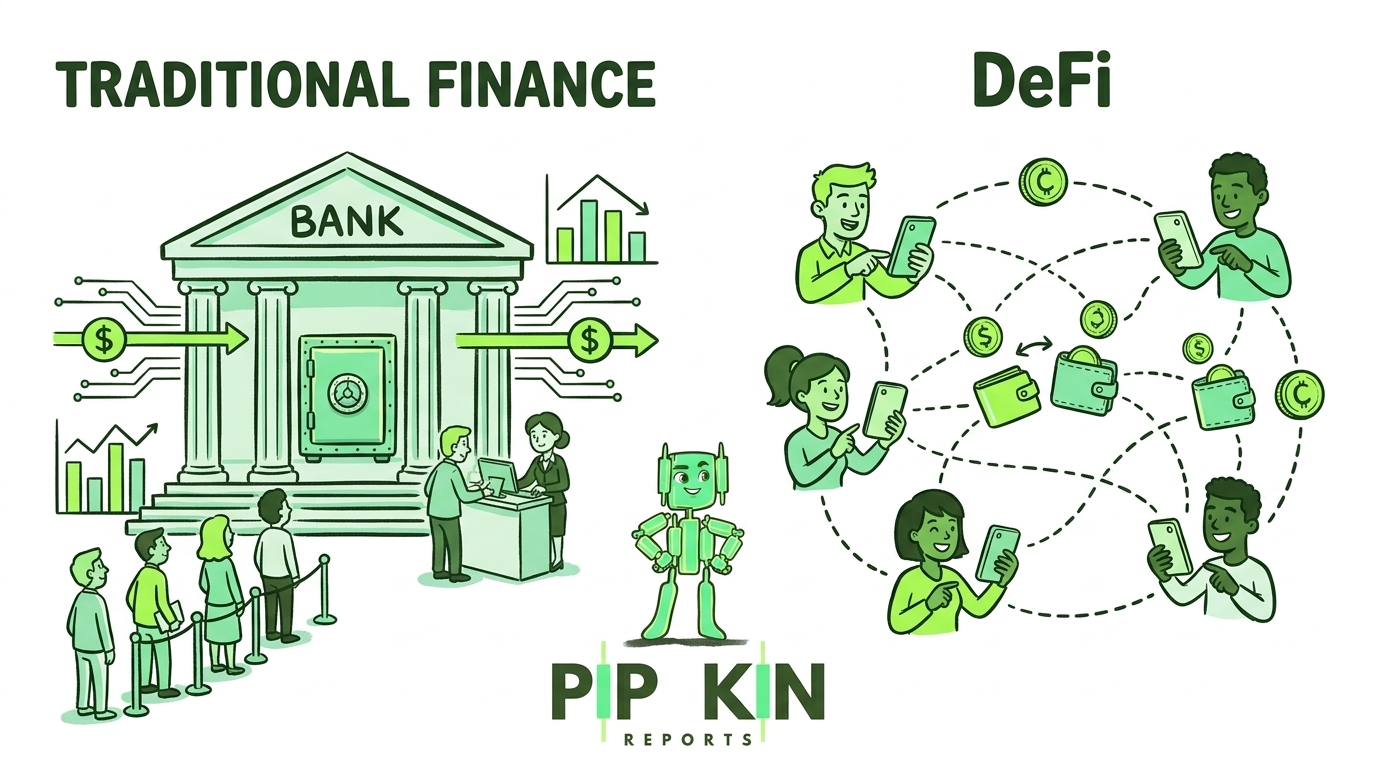
DeFi stands for Decentralized Finance, and it describes financial services that run on blockchains rather than through banks. This matters because blockchains do not depend on a single company, and because they run across many computers the system resists shutdowns and censorship.
In traditional finance a gatekeeper approves each action; for example a bank approves loans, a broker clears trades, and a card network signs off on payments. In DeFi that gate is removed, so anyone with a wallet and an internet connection can join. When access expands, competition rises, and competition often lowers costs. Could such openness reshape who gets to participate in the economy?
Think of traditional finance as a walled garden that is tidy but limits who can enter. By contrast, DeFi is an open field where anyone can walk in and build, and that openness invites creativity that produces new services.
Hence, the clearest answer is that DeFi is finance redesigned for the digital age. It is global, permissionless, and transparent by default. In short, we can say that DeFi is the money management of digital assets. You can learn all about digital assets, their types and usecase in our guide “what are digital assets” for better understanding.
How DeFi Works?
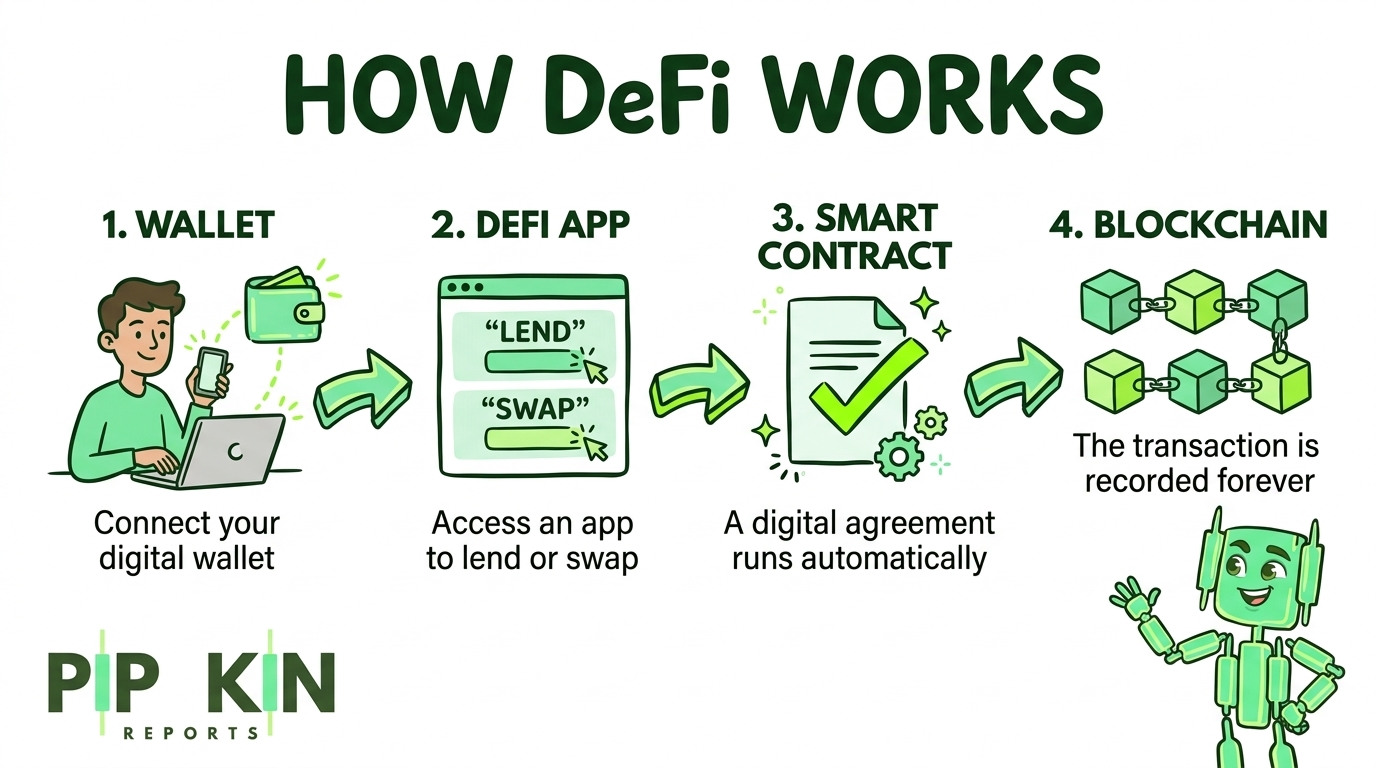
DeFi works because three parts connect and support one another: blockchains, smart contracts, and wallets. Each piece matters and each piece enables the next.
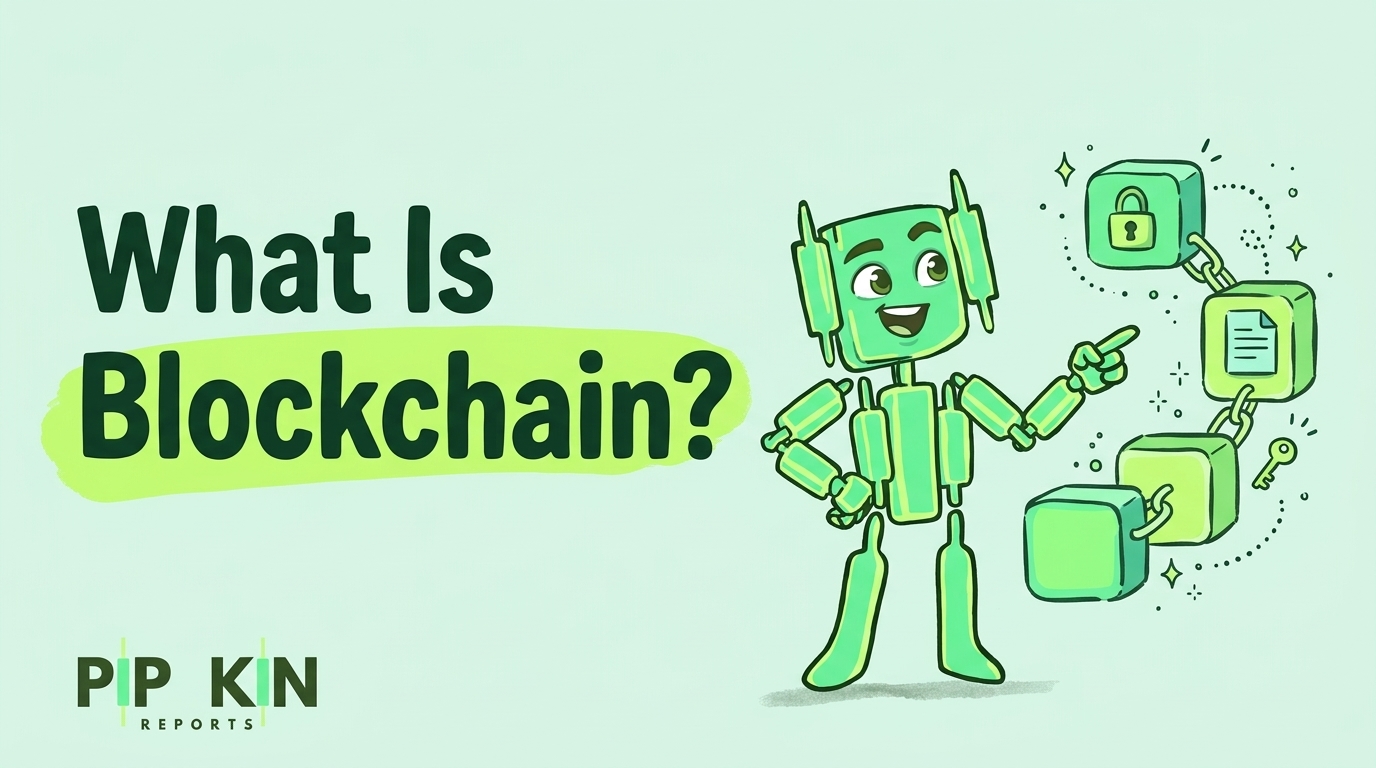
- First, blockchains record activity in a shared ledger that many computers hold. New entries must follow agreed rules, so the ledger creates trust without a central bookkeeper. Because many people can verify the ledger, no one can quietly change entries later. Would you not prefer a financial record that anyone can check and no one can secretly alter?
- Second, smart contracts run the logic. A smart contract is code on the blockchain that contains rules for actions such as lending and trading. When the conditions are met the contract executes automatically without human approval, and that reduces counterparty risk because the contract cannot choose to ignore its own code.
- Third, wallets connect people to contracts. A wallet such as MetaMask stores your keys, and your keys let you sign transactions. Your signature proves ownership, so you can act by proof rather than by permission.
To see how these parts work together imagine this flow. You open a wallet, you choose a DeFi app, you click connect, and you pick an action such as lend or swap. The contract checks your balance and the rules, and if everything is correct the contract executes the action while the blockchain records the result. Because every step is visible, anyone can audit it later. Therefore, the ledger gives integrity, the contract gives automation, and the wallet gives access.
Components of Decentralized Finance
Now let’s unpack each main component. This will show what is defi ecosystem in practice. It will also show why each choice matters.
1- Blockchains
Blockchains form the base layer of DeFi, and they work like roads that carry every transaction from one point to another. If the road is secure, then the applications built on top of it feel safe to use, but if the road becomes congested, those same applications will feel slow and frustrating.
Ethereum is the most widely used foundation for DeFi because it prioritizes security and decentralization, which are critical in environments where valuable transactions occur. However, other chains play an important role too.
For instance, Solana focuses on speed, Avalanche emphasizes flexible scaling, and BNB Chain is designed for lower fees. Each of these approaches attracts different types of users, and this diversity creates resilience since no single blockchain can meet every possible need. So, if you had to choose, would you prefer maximum safety, faster speed, or cheaper transactions for the apps you use?
2- Smart Contracts
Smart contracts act as the engines of DeFi because once they are deployed, they continue to run without interruption and enforce rules exactly as written. This reliability removes human bias and eliminates delays.
For example, imagine a lending contract that requires borrowers to keep collateral above a set ratio. If the value of that collateral drops, the contract will automatically liquidate a portion of it, and it will do so instantly to protect lenders. By embedding risk controls directly into code rather than leaving decisions to a committee, DeFi reduces credit risk, since the contract follows the rule consistently and without exceptions.
3- Cryptocurrencies
Cryptocurrencies function as the fuel for the ecosystem. Native coins such as ETH pay for transaction fees, while stablecoins like USDC, USDT, and DAI act as digital dollars. Stablecoins are particularly important because people prefer stable value when dealing with loans and savings.
Consequently, most lending activity in DeFi happens in stablecoins. When the value of money remains steady, users feel less stress, and this sense of stability encourages broader adoption.
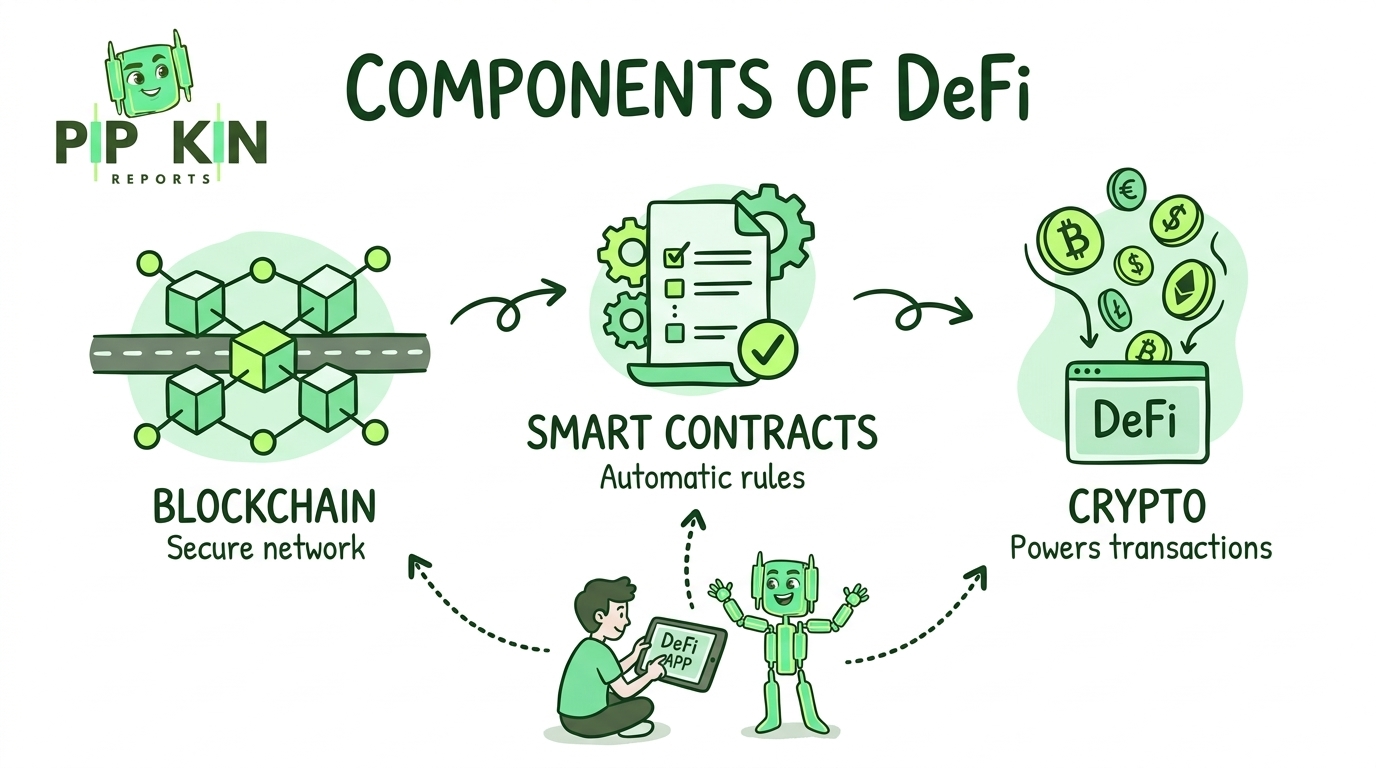
Taken together, these three components form the foundation of the DeFi ecosystem that crypto users rely on: the blockchain secures the system, the smart contract automates the process, and the cryptocurrency powers transactions and stores value.
CeFi vs DeFi
Now let us check how traditional finance differs from decentralized finance.
To start, traditional finance centralizes control: a bank holds your balance, a clearing house settles trades, and a network routes payments.
Centralization can deliver customer service, yet it can also introduce delay and fees, and it can exclude people who lack documents or credit history.
Whereas DeFi decentralizes control because you hold your keys, the contract settles trades, and the network itself routes payments. Reducing permissions increases access, but it also increases personal responsibility.
Transfers in banks can take days because many parties reconcile records, whereas transfers in DeFi settle within minutes because all parties write to one ledger. Bank fees typically fund branches and staff, while DeFi fees pay for network security; each model simply chooses where to place costs.
Therefore, the right choice depends on needs: if you want support and reversals then a bank is useful, and if you want speed and openness then DeFi can help. Most people will touch both systems because each solves different problems well. Which model fits your priorities?
Comparison Table: DeFi vs Traditional Finance
| Feature | CeFi (Centralized Finance) | DeFi (Decentralized Finance) |
| Control | Controlled by banks, exchanges, or companies | Controlled by users through smart contracts |
| Access | Requires accounts, ID, and approval | Open to anyone with a wallet and internet |
| Custody | Platform holds your funds | You hold your own private keys |
| Transparency | Limited, depends on company reports | Full transparency on blockchain |
| Speed | Transactions can be slow with intermediaries | Transactions are fast and often instant |
| Risks | Hacks of centralized exchanges, company mismanagement | Smart contract bugs, self-custody risks |
| Support | Customer service available | No hotline—users manage their own security |
Advantages of DeFi
DeFi offers several clear benefits that arise from its design choices.
- Open access: Anyone with a smartphone and internet can join, helping over a billion unbanked adults participate.
- Speed & availability: Runs 24/7 with fast settlement, freeing up cash for growth.
- Transparency: Public ledgers allow auditing, building trust and reducing hidden fees.
- Self-custody & control: Users hold keys and approve actions, increasing financial sovereignty.
- Composability & innovation: Apps plug into each other, enabling faster and cheaper solutions.
- Global reach: Borderless access connects borrowers and lenders worldwide, boosting competition and lowering rates.
These advantages appear because the system is open, automated, and verifiable. Do these benefits change how you think about everyday finance?
Disadvantages of DeFi
Now let us be candid about the risks, since each risk also has a root cause and that root cause follows from the same design choices that create benefits.
- Complexity: New users face private keys, gas fees, and slippage, requiring education to avoid mistakes.
- Smart contract exploits: Code bugs can be exploited quickly; audits help but cannot fully eliminate risk.
- Market volatility: Crypto swings and leverage can trigger liquidations; overcollateralization protects lenders but raises borrowing costs.
- Self-custody risks: Losing your private key means permanent loss; social recovery and multi-sig help but need planning.
- Regulatory uncertainty: Evolving rules vary by region, increasing compliance costs and slowing growth.
Therefore, the same traits that create benefits in DeFi also create risks. Openness increases access but also expands the attack surface. Immutability ensures fairness but also locks in errors. Self-custody grants complete control but simultaneously removes traditional protections. Hence, understanding these tradeoffs is essential for anyone who wants to use DeFi safely.
Uses of DeFi
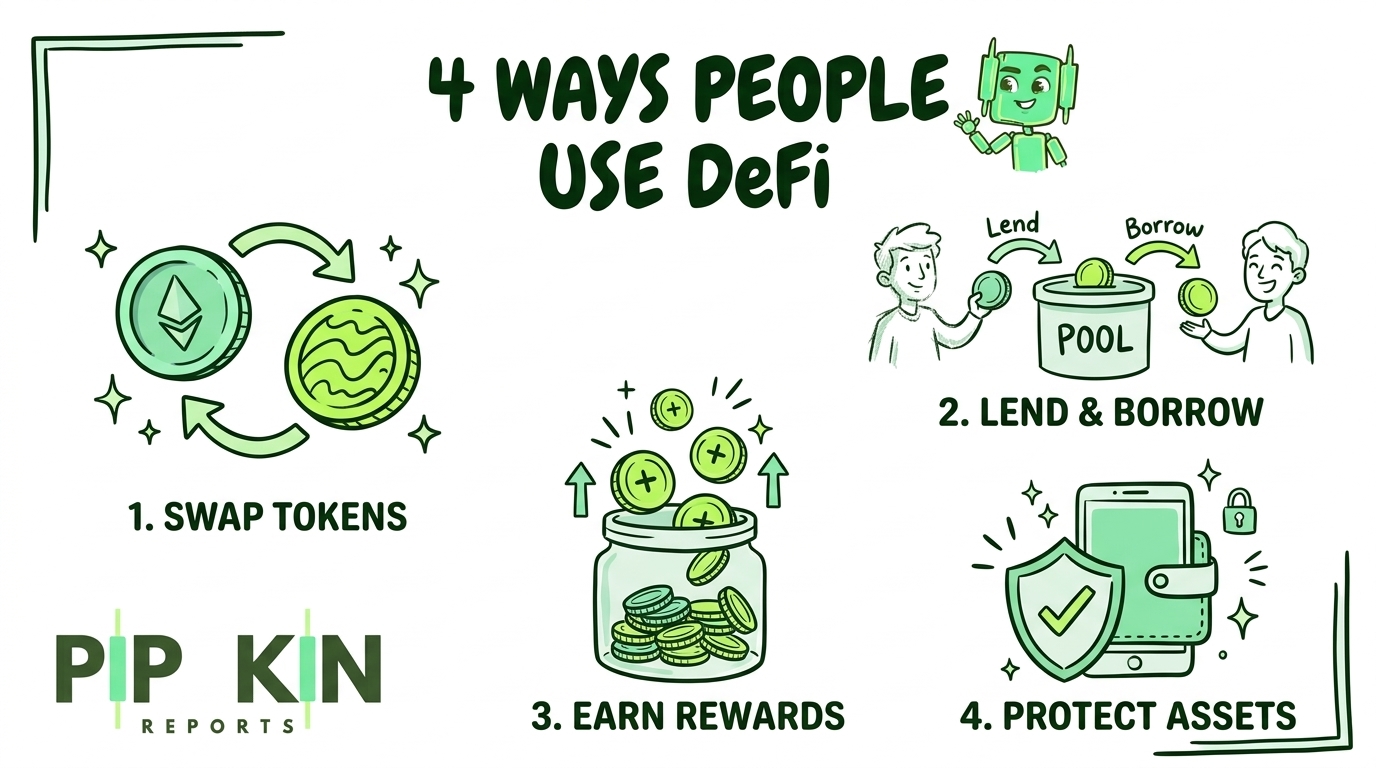
Use cases make ideas feel real, and the examples below show how DeFi functions in practice.
1- Decentralized Exchanges (DEXs)
Decentralized exchanges allow people to trade tokens directly without relying on intermediaries. They work through automated market makers (AMMs), which use formulas such as the constant product curve to quote prices. This formula ensures that a price always exists, even without a traditional order book.
As a result, anyone can trade at any time. This design removes the need for centralized custody and avoids listing restrictions, which lowers barriers for new tokens and increases variety. Moreover, greater variety attracts more traders, and more traders attract liquidity providers.
This, in turn, increases liquidity, reduces price slippage, and improves prices for everyone. Examples include Uniswap, which supports a wide range of trading pairs, and Curve, which specializes in stablecoin pairs where tight pricing is most important. Would you rather trade on an exchange controlled by one company, or one that runs entirely on code and liquidity pools?
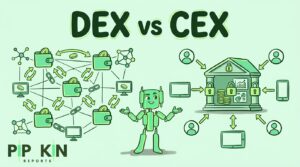
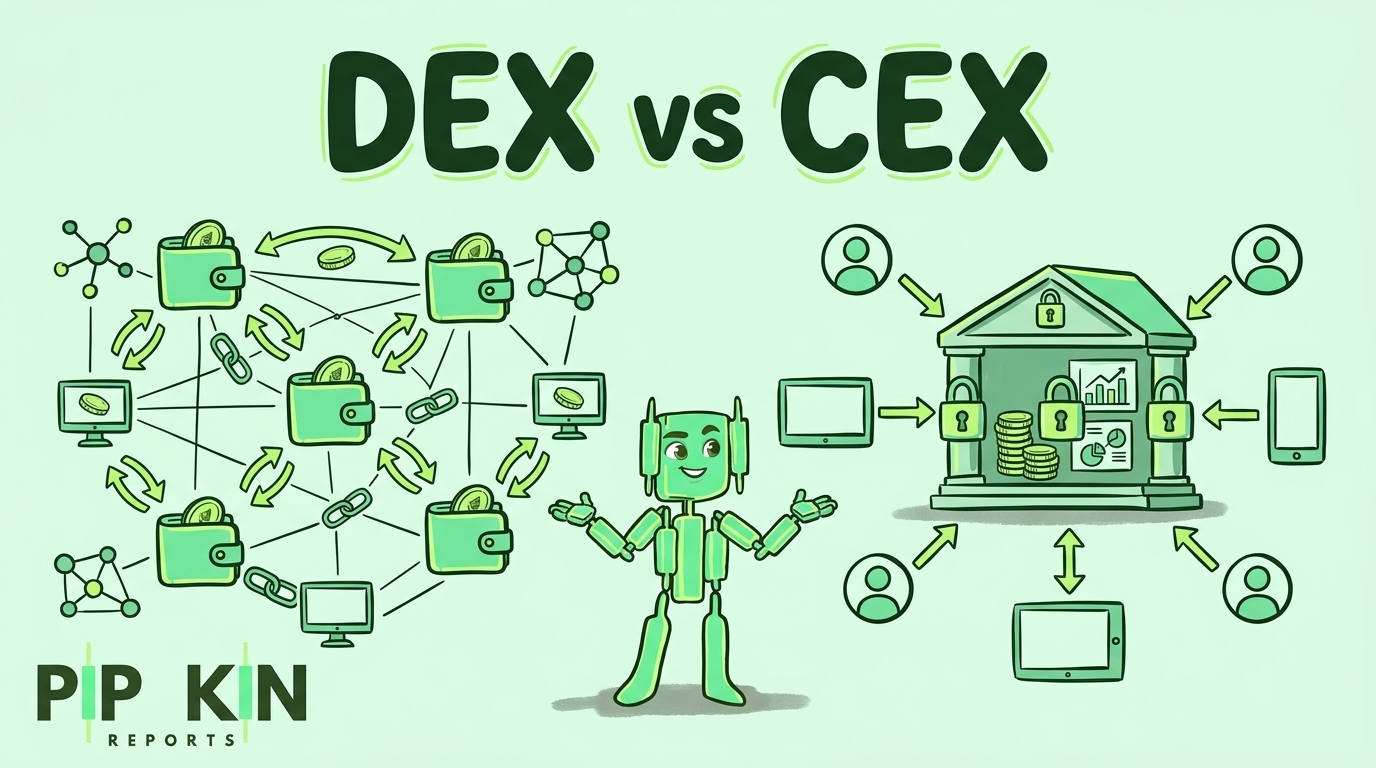
To learn more about the difference between centralized and decentralized exchanges, read our comprehensive guide on “DEX Vs CEX“.
2- Lending & Borrowing
DeFi lending platforms pool user deposits and allow others to borrow against posted collateral. Most systems require overcollateralization. For instance, you might deposit $150 worth of collateral to borrow $100. This structure protects lenders in case prices drop, because the contract can liquidate some collateral instantly. Fast liquidation maintains solvency across the system.
Therefore, DeFi enables instant loans without credit checks, since risk is controlled by collateral instead of personal identity.
Examples include Aave and Compound, which both use asset-specific risk settings such as loan-to-value ratios and liquidation thresholds to balance growth and security. Isn’t it interesting how you can borrow without ever revealing your name, simply because math and code handle the risk?
3- Staking
Staking secures proof-of-stake networks by requiring users to lock coins that support validators, who then process blocks and keep the chain honest. In return, stakers receive rewards, and these rewards align incentives by linking user profits directly to network health.
Furthermore, the more value that is staked, the higher the cost of an attack becomes, which in turn increases security.
Examples include native staking on Ethereum as well as liquid staking protocols like Lido. Liquid staking adds flexibility by giving users a receipt token that can be used in other DeFi applications.
This increases utility but also introduces new risks, since these tokens carry additional layers of dependency. Hence, staking is both a security mechanism and a potential opportunity for users to earn, though it requires awareness of the tradeoffs.
4- Insurance
DeFi insurance pools capital to cover events such as hacks and often uses parametric rules where a claim triggers when objective conditions are met, such as a contract address losing funds.
Parametric rules speed payouts and restore confidence, and services such as Nexus Mutual and Unslashed help users hedge smart contract risk; hedging lets institutions participate with clearer risk controls.
5- Synthetic Asset Issuance
Synthetic assets mirror real-world prices on-chain by using collateral and price oracles, and if the asset price rises the system adjusts collateral and debt accordingly. This mechanism lets users gain exposure without holding the real asset, and exposure without custody reduces settlement friction while reduced friction broadens access.
Examples include Synthetix and MakerDAO: MakerDAO issues DAI, a decentralized stablecoin backed by collateral, and Synthetix issues synthetic assets tied to indices, commodities, and more.
These use cases exist across many chains, and together they illustrate top DeFi projects and some of the best DeFi platforms in daily use. Which use case would you try first?
| Use Case | What It Means | Examples |
| Decentralized Exchanges (DEXs) | Trade tokens directly without intermediaries | Uniswap, Curve |
| Lending & Borrowing | Lend assets to earn yield or borrow against collateral | Aave, Compound |
| Staking | Lock coins to secure networks and earn rewards | Ethereum staking, Lido |
| Stablecoins | Crypto assets pegged to stable value for payments and savings | USDC, DAI |
| Yield Farming & Liquidity Pools | Provide liquidity to earn fees and rewards | Uniswap Pools, Yearn Finance |
| Derivatives & Synthetic Assets | Trade assets linked to real-world or crypto markets | Synthetix, dYdX |
| Payments & Remittances | Send money globally with low fees and fast settlement | USDT transfers, Lightning wrapped into DeFi |
The Future of DeFi
The future brings new tools and new tests, and each path has upside and risk that deserve careful reasoning.
Regulations
Clear rules can attract mainstream users by defining disclosures, audits, and consumer protections, and when rules reduce legal risk for builders investment tends to follow. However, heavy-handed rules could push activity offshore and lower transparency, so balanced policy matters; it should target outcomes such as truthful reserves and fair access while avoiding bans of neutral tools.
Artificial Intelligence
AI can help with risk scoring, fraud detection, and user guidance by flagging abnormal flows and suggesting safer actions, and it can also personalize education inside wallets so users make better choices. Better guidance reduces mistakes and increases trust, yet AI must be verifiable because black box models can introduce bias. DeFi values transparency, and therefore AI in DeFi should explain its reasoning and log its steps.
Quantum Computing
Quantum computers could threaten current cryptography used in wallets because algorithms such as Shor’s could break common signatures, and that risk motivates work on quantum resistant schemes. Projects are testing new signature types and migration paths, and early planning matters because key upgrades require user coordination; coordination takes time, and starting early lowers transition risk.
Layer-2 and Beyond
Layer-2 networks scale Ethereum by batching transactions and posting proofs back to the base chain, and batching lowers fees and raises speed so lower fees open DeFi to smaller users while higher speed enables more complex apps.
There are tradeoffs: different rollups choose different proof systems, with some using optimistic proofs that involve challenge windows and others using zero-knowledge proofs that rely on heavier math. Each path balances cost, finality time, and security assumptions, and over time bridges and shared standards can connect many chains so that better connections create a more seamless, multi-chain money layer.
DeFi Ecosystem Explained Briefly
So, what is the DeFi ecosystem in one view? It is a stack: the base is a secure chain, the middle is transparent contracts, and the top is user apps that solve real problems. Governance tokens and stablecoins link incentives, oracles bring off-chain data, wallets bring people, analytics bring visibility, and education brings safety. When every layer improves adoption will grow and builders will iterate faster. Do you see how the pieces fit together to form a new financial stack?
Best DeFi Platforms and Top DeFi Projects
Following are some of the best Defi platforms:
| Platform | Main Use |
| Uniswap | Token swaps through AMMs |
| Curve | Stablecoin trading with low slippage |
| Aave | Lending and borrowing |
| Compound | Money markets for earning/lending |
| MakerDAO | Creation of DAI stablecoin |
| Synthetix | Synthetic assets and derivatives |
| Lido | Liquid staking for PoS tokens |
| Nexus Mutual | Decentralized insurance cover |
These names matter because they show mature designs, strong communities, and real usage; real usage then proves product-market fit, and product-market fit attracts developers who improve features that attract more users. The cycle feeds itself.
Wrapping Up
DeFi reimagines finance as open, programmable, and borderless. It uses blockchains for trust, smart contracts for automation, and wallets for access. Moreover, it already offers exchanges, lending, stablecoins, and insurance that run without middlemen.
The benefits include inclusion, speed, and transparency, while the risks include bugs, volatility, regulation, and complexity. Hence, the challenge for the future is to expand benefits while reducing risks.
Will DeFi replace banks entirely? Probably not. But it may pressure them to innovate and to serve more people fairly. Therefore, understanding DeFi is not optional if you want to see where money is heading. The question is simple: when finance becomes as open as the internet, will you choose to take part?