Think of a restaurant in your city. One of them has alot of customers. Every table is crowded, waiters are moving quickly, and the kitchen is sending out food nonstop. People trust this place because many others have already chosen to eat there. Now picture another restaurant right across the street. Its menu has almost the same dishes, but only a few tables are occupied there. Even if the food tastes just as good, the empty space makes you hesitate. Would you not prefer to walk into the busier restaurant instead? Obviously, yes. This same logic helps explain what is TVL in crypto.
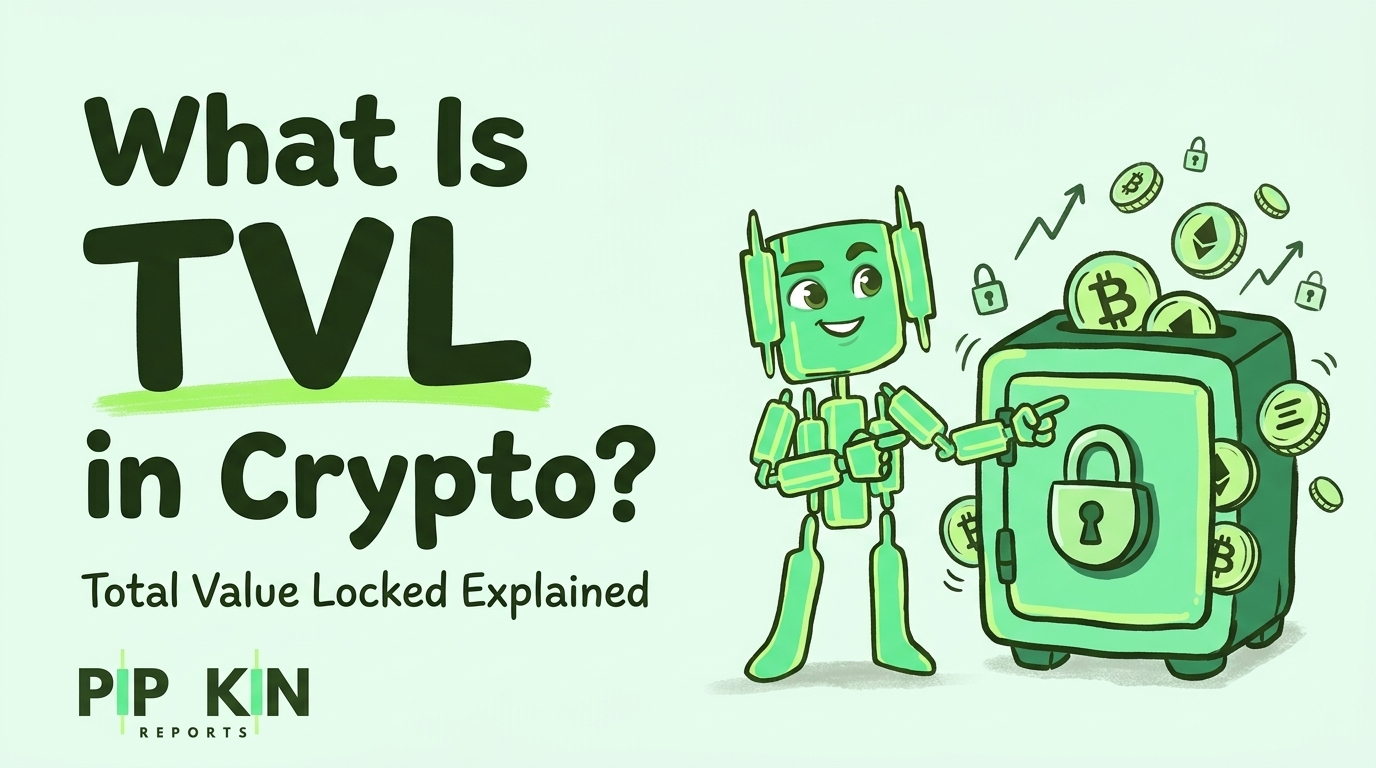
TVL, or total value locked, in simple terms shows the amount of assets that are locked inside a protocol. These can include tokens stored in lending vaults, staking systems, or liquidity pools. The rule is simple though; a higher TVL indicates stronger confidence among users. Just like the busy restaurant, a protocol with a higher blockchain TVL is considered more active, trusted, and reliable.
Meanwhile, TVL does not remain the same. Just like restaurants grow in popularity and sometimes lose customers, TVL also rises and falls with time.
How Can We Calculate TVL of any Project?
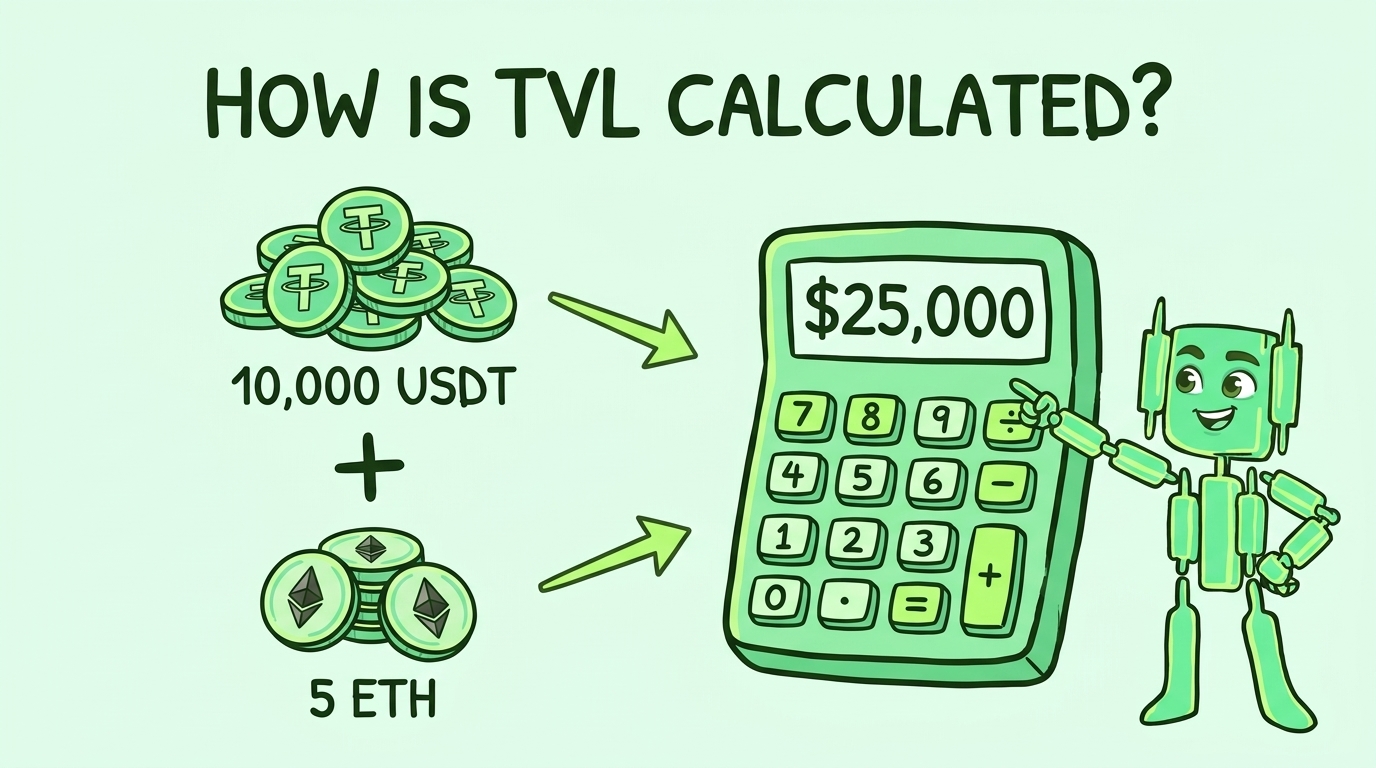
The basic calculation is simple in theory. It adds up all tokens locked in a protocol and values them according to current market rates.
To illustrate, imagine a protocol holding 10,000 USDT and 5 ETH. If ETH is trading at $3,000, the total value is $10,000 plus 5 multiplied by $3,000, which equals $25,000.
However, real protocols are more complex than this simple example.
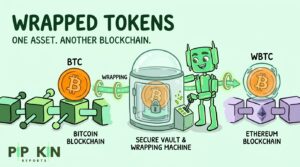
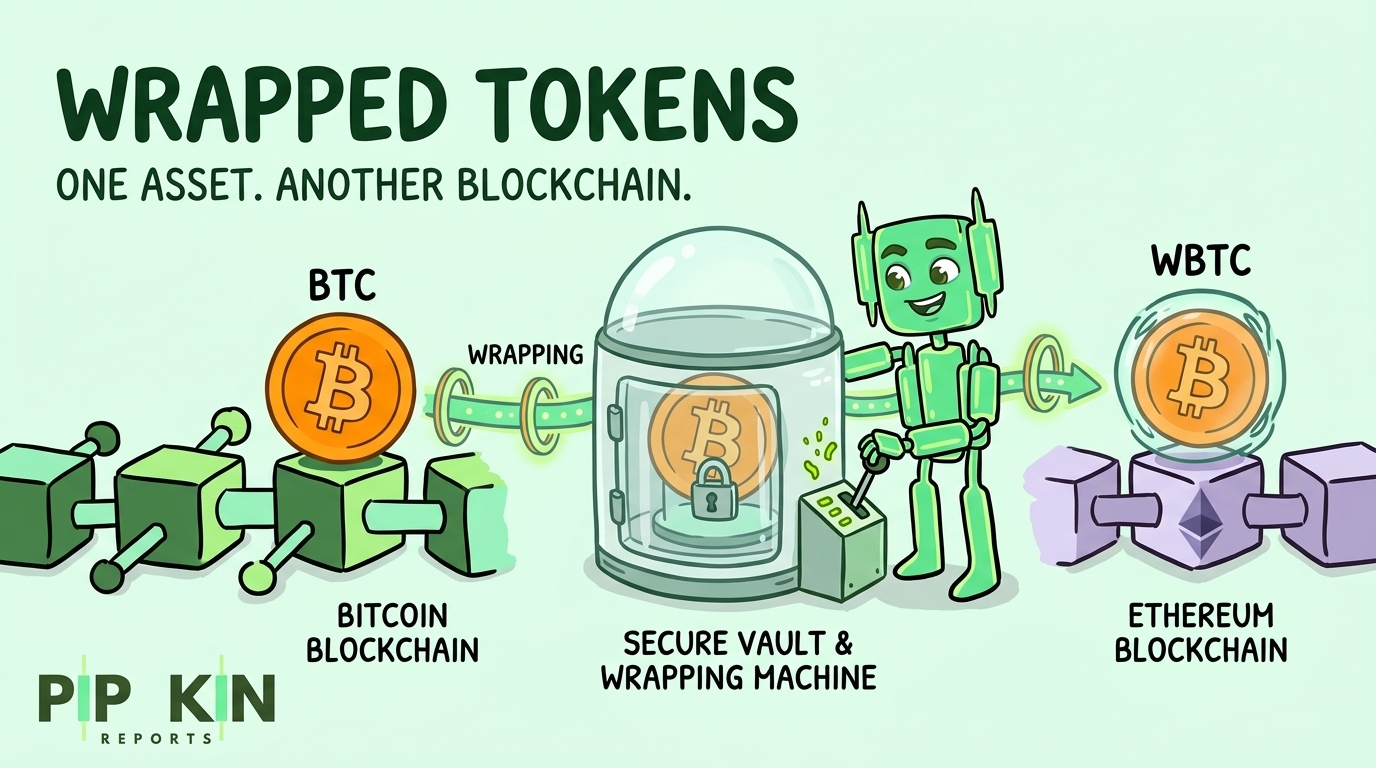
- In reality, wrapped tokens such as WBTC must be connected back to the original coins.
- Meanwhile, liquidity tokens represent shares in pools, so they must be broken down into the actual assets inside them.
- Furthermore, staking rewards are also included in the calculation, since they remain locked in the system.
In short, TVL is a detailed form of accounting that carefully includes every locked dollar. Now you must remember that these dollars can be in any form including ETH, stablecoins, or wrapped tokens.
Once we understand how it is measured, the next important question is what does TVL mean or what influences it?
What Factors Influence TVL?
You may now be asking what really makes TVL move up or down. To answer this, let us look at the main factors that influence TVL and see how each of them plays a role.
1- Liquidity
To explain, liquidity can be compared to water inside a well. If the well is full, people can take water whenever they need it without concern.
Similarly, in crypto, liquidity represents how easily assets can be bought, sold, or borrowed without large price changes. Hence, a protocol with strong liquidity allows smooth trades and loans. This reduces risk for users and encourages more deposits. However, when liquidity is low, trading becomes harder at that protocol, prices can change suddenly, and users hesitate to lock in crypto at that project. Ultimately, this leads to a lower TVL.
2- Staking
Staking is similar to locking gold in a town vault to pay guards who protect the community. When staking rewards are attractive, more users are willing to lock their tokens, which pushes TVL higher.
For instance, if a blockchain validator offers 10 percent annual rewards, users may decide to stake more ETH or native tokens to receive their share. On the other hand, if rewards fall or if risks rise, users withdraw their tokens, and TVL decreases. Staking therefore reflects both trust in the protocol’s security and the appeal of rewards.
3- Yield Farming
Yield farming works like planting crops. A generous harvest motivates farmers to plant more seeds. In crypto, protocols offer high yield incentives to attract deposits. Users quickly move their tokens into these systems to earn extra returns, which causes TVL to rise.
However, once those incentives end, users usually withdraw their funds, and TVL falls again. Yield farming demonstrates how temporary incentives can create sharp swings in TVL that do not always reflect long-term trust.
4- Market Volatility
TVL is also shaped by the prices of the underlying assets. Think of a warehouse filled with goods. If the value of each unit doubles, the total warehouse value also doubles even though the quantity of goods has not changed.
Similarly, in crypto, if ETH or BTC prices rise, the TVL of protocols holding them also rises. If their prices fall, TVL decreases even if the amount of tokens remains unchanged. This shows that TVL meaning crypto is not always about user confidence but sometimes simply about market changes.
5- Protocol Design
The way a protocol is built also matters. A well-designed application with smooth navigation, strong security audits, and protective features attracts more deposits. Extra options like cross-chain compatibility or TVL protect insurance on funds build even greater trust.
In contrast, a poorly designed protocol with weak security or confusing interfaces discourages users, leading to a lower TVL. This shows that both user experience and safety play a direct role in how much value people are willing to lock.
All of these forces work together rather than separately. Liquidity, rewards, market prices, and design interact with one another, and together they determine the direction of TVL.
The Risks and Limits of TVL
TVL is useful, but it also has important limits. To understand these limits clearly, let us look at them step by step.
1- Price Dependence
TVL depends heavily on token prices. Imagine you deposit 10 ETH into a lending platform. If each ETH is worth $3,000, the TVL adds up to $30,000. If the price of ETH falls to $2,400, the same 10 ETH is now worth $24,000. The TVL shows a drop of $6,000 even though you never withdrew your funds. This means TVL sometimes reflects price movements in the market rather than a real change in how much people trust or use a protocol.
2- Double Counting
In crypto, digital assets can be reused across platforms, which can lead to misleading numbers. For example, you may lock ETH in Protocol A and receive a token that represents your deposit. If you then take that token and deposit it into Protocol B, both platforms may count the value. The same $10,000 suddenly appears as $20,000 across two platforms. Therefore TVL can exaggerate the real scale of activity and give the impression of more growth than there is.
3- Incentive Distortions
Platforms often use rewards to attract deposits. This is similar to a store offering big discounts to bring in more customers. When the rewards are high, people rush to deposit funds, and TVL rises quickly. However, once those rewards are reduced or removed, many users move their funds elsewhere, and TVL falls again. This shows that TVL can sometimes reflect temporary incentives rather than long-term trust or stability.
4- Security Blind Spot
TVL measures how much value is locked in a protocol, but it does not measure how safe that value is. A platform could hold billions in deposits while still being vulnerable to coding flaws, scams, or hacks. History has shown that some high-TVL platforms were exploited and lost millions within minutes. This means TVL is not enough to judge the safety or reliability of a protocol.
Because of these limits, TVL should always be read with care. It is a helpful signal of activity, but it must be studied together with other measures to avoid being misled.
Pros and Cons of TVL
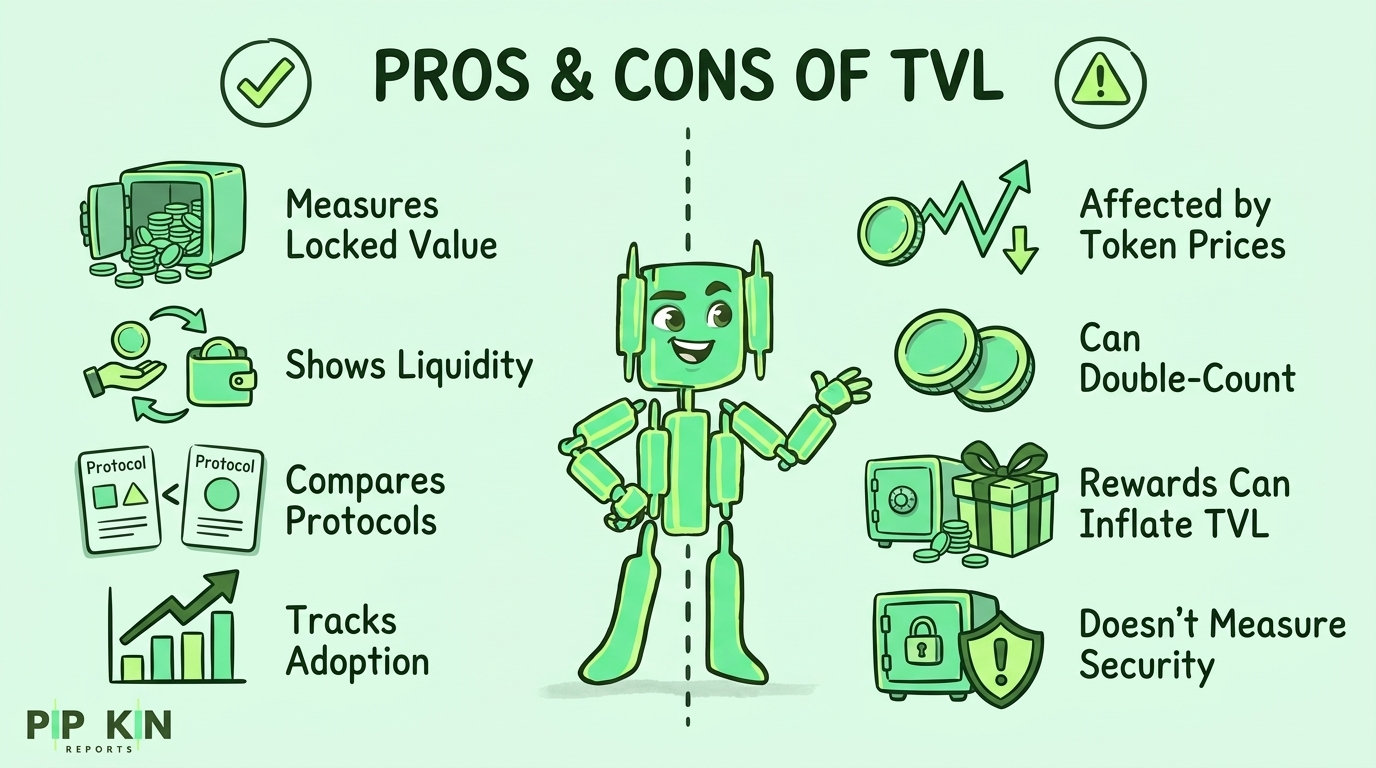
Let us take a quick glance at the benefits and limitations of total value locked (TVL).
| Pros | Cons |
| Shows how much value is actively locked in a protocol, which helps measure scale and participation | Strongly affected by token prices, so it can rise or fall even without deposits or withdrawals |
| Acts as a quick signal of confidence, since higher TVL usually means more users trust the platform | Can involve double counting when tokens are reused across multiple platforms |
| Helps measure liquidity for lending, borrowing, and trading, making transactions smoother | Can be inflated by rewards, since incentives often draw deposits only for the short term |
| Useful for comparing the size of different protocols or ecosystems, such as Ethereum compared to other blockchains | Does not measure safety, so even high-TVL protocols can be hacked or exploited |
| Tracks adoption trends over time, showing whether a platform or ecosystem is growing | Can mislead if used alone without considering other metrics like revenue, trading volume, or user activity |
Comparison of TVL with Different Measures
While TVL is important, it does not give the complete picture of a protocol’s health. To get a deeper understanding, it must be compared with other measures.
- TVL Vs Trading Volume: TVL shows assets that are locked and at rest, while trading volume shows value in motion. A decentralized exchange may have high TVL but very few daily trades, which means its funds are idle. Another exchange may have a lower TVL but a large amount of daily trading, showing that it is actively used. Trading volume therefore highlights the difference between locked but inactive funds and locked funds that actively support market activity.
- TVL Vs Market Cap: Market cap shows the total market value of a project’s tokens rather than actual deposits. A project may have a large market cap but very little TVL, which points to speculation rather than usage. On the other hand, a project with high TVL and a fair market cap shows stronger adoption and actual use. Comparing TVL with market cap reveals whether value is backed by participation or simply by price speculation.
- TVL Vs Revenue: Revenue reflects the actual income a protocol earns, usually from fees. A platform may have high TVL but little revenue, which means it is not generating steady income and depends on continuous inflows. A smaller platform with lower TVL but reliable revenue can be more sustainable. Revenue therefore provides insight into a protocol’s economic strength.
- TVL Vs Active Users: Sometimes TVL can be concentrated among just a few large holders. This makes the system fragile. For example, a lending protocol that holds 90 percent of its funds from only five whales is less secure than one with thousands of smaller contributors. A wider base of active users indicates broader trust and stronger resilience.
When TVL is studied together with trading volume, market cap, revenue, and user activity, it gives a clearer and more accurate view of how healthy a protocol really is.
Analyzing TVL Meaning for Different Projects
TVL does not mean the same thing across all protocols. Context is crucial in interpreting it. Let us see how to analyze TVL of various projects!
Lending Systems
In lending systems, TVL represents the funds supplied by users for borrowing. If borrowing activity matches supplied funds, the system works efficiently. If the funds remain unused, efficiency is low. The type of collateral also matters. Volatile tokens create more risk, while stablecoins reduce it. A high TVL alone does not guarantee profitability. What matters is whether supply and demand are balanced.
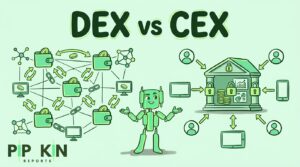
Decentralized Exchanges (DEXs)
In decentralized exchanges, TVL shows the liquidity inside trading pools. Higher liquidity lowers slippage and ensures smoother trades. If liquidity is concentrated in only one or two pairs, the system is weak and more exposed to price swings. If liquidity is spread across many popular pairs, the exchange is stronger and more reliable.
Staking Protocols
In staking protocols, TVL reflects how much trust users place in validators or staking tokens. If staked tokens hold their value and remain liquid, users continue staking. If tokens lose value or become hard to withdraw, people quickly exit, and TVL declines. This means that both token trust and staking rewards affect locked value.
Cross Chain Bridges
Bridges allow assets to move between different blockchains. TVL here shows how much value is being actively bridged. However, care is needed to avoid double-counting, because assets may appear both as originals and as wrapped tokens. Bridges with verified deposits and genuine cross-chain activity are considered stronger.
Layer-2 Systems
For Layer 2 systems, TVL indicates how much confidence users place in them for scalability. Higher TVL shows that users trust the network to handle transactions faster and cheaper than the main chain. This is a clear signal of adoption.
Every protocol type uses TVL differently, which is why context is always necessary when interpreting its meaning.
Wrapping Up
Returning to the restaurant example, a crowded dining hall makes you feel confident about eating there, while an empty one makes you pause and reconsider.
TVL works in the same way. It shows where people are locking their funds and where trust is gathering. However, TVL on its own is not enough. Prices, incentives, design, and other metrics are also important.
When used carefully and compared with other indicators, TVL becomes a powerful tool to understand crypto protocols. When used alone or misinterpreted, it can be misleading. Therefore, always compare TVL with other signals to get the real picture of a project’s health, adoption, and growth potential.