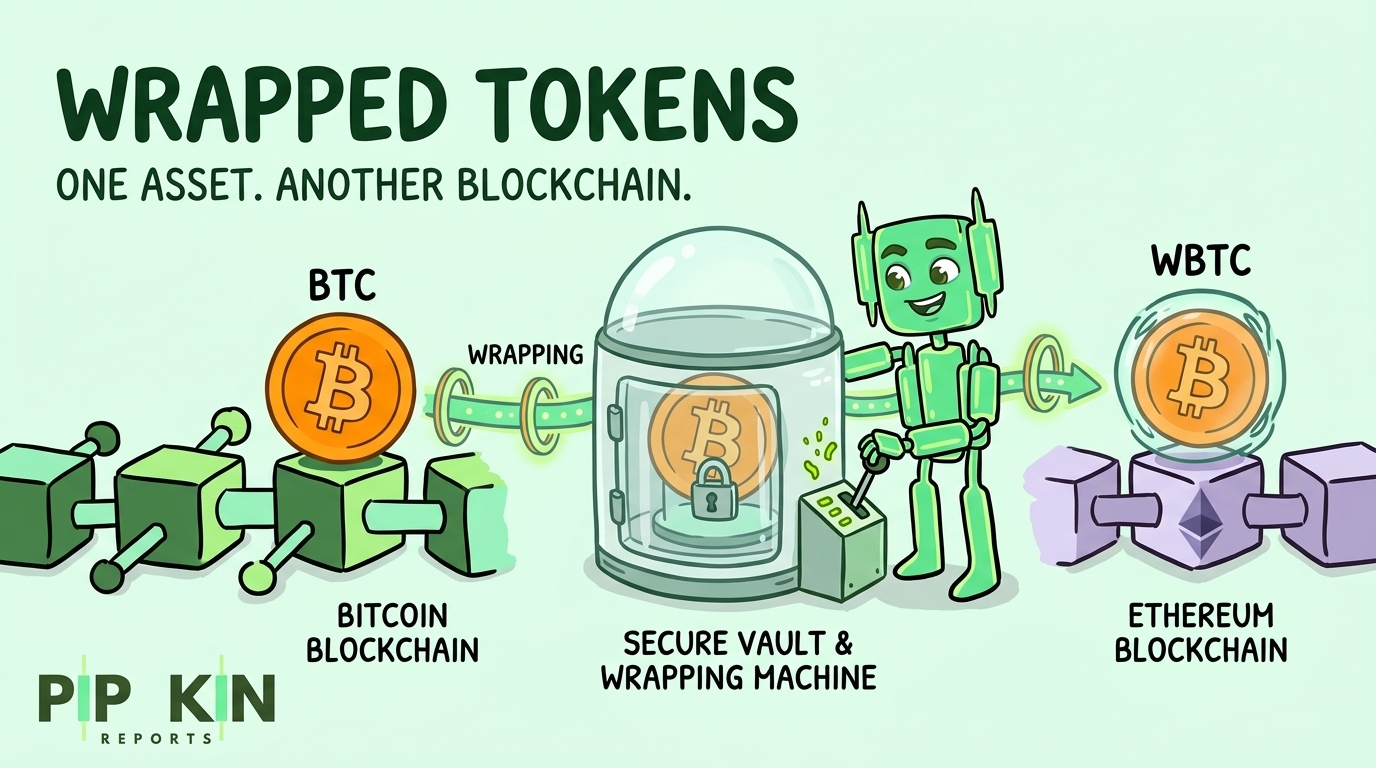
We shall start with the simplest question: what are wrapped tokens?
To illustrate, consider cryptocurrencies that are bound up within their respective blockchains. They do not work outside of their system. However, with the expanding crypto world, users desire to transfer their assets across chains. It is here one can see wrapped tokens come into play. What is a wrapped crypto coin? It is nothing more than a digital representation of an already existing cryptocurrency. It is designed to operate on a different blockchain.
As an easier way to visualize it, think about purchasing a toy in one store, but your friend on the birthday occasion only accepts gifts on a certain type of paper. It is not the toy you change. Instead, you package it in a way that is according to the rules of the party.
Similarly, wrapping tokens does not transform the coin. The initial value remains unchanged. The token, however, can be used on a different blockchain with the help of a wrapper.
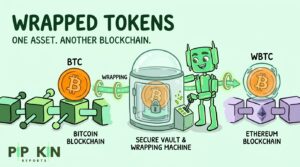
As an example, Ethereum cannot naturally operate with Bitcoin. But wrapped Bitcoin (WBTC) allows users to bring Bitcoin into the applications of Ethereum. Hence, what is wrapped crypto becomes clear: wrapping provides a mean by which blockchains which would otherwise be unable to communicate with one another are linked together.
With this concept in mind, the other question that arises is, how do wrapped tokens work?
How Do Wrapped Tokens Work?
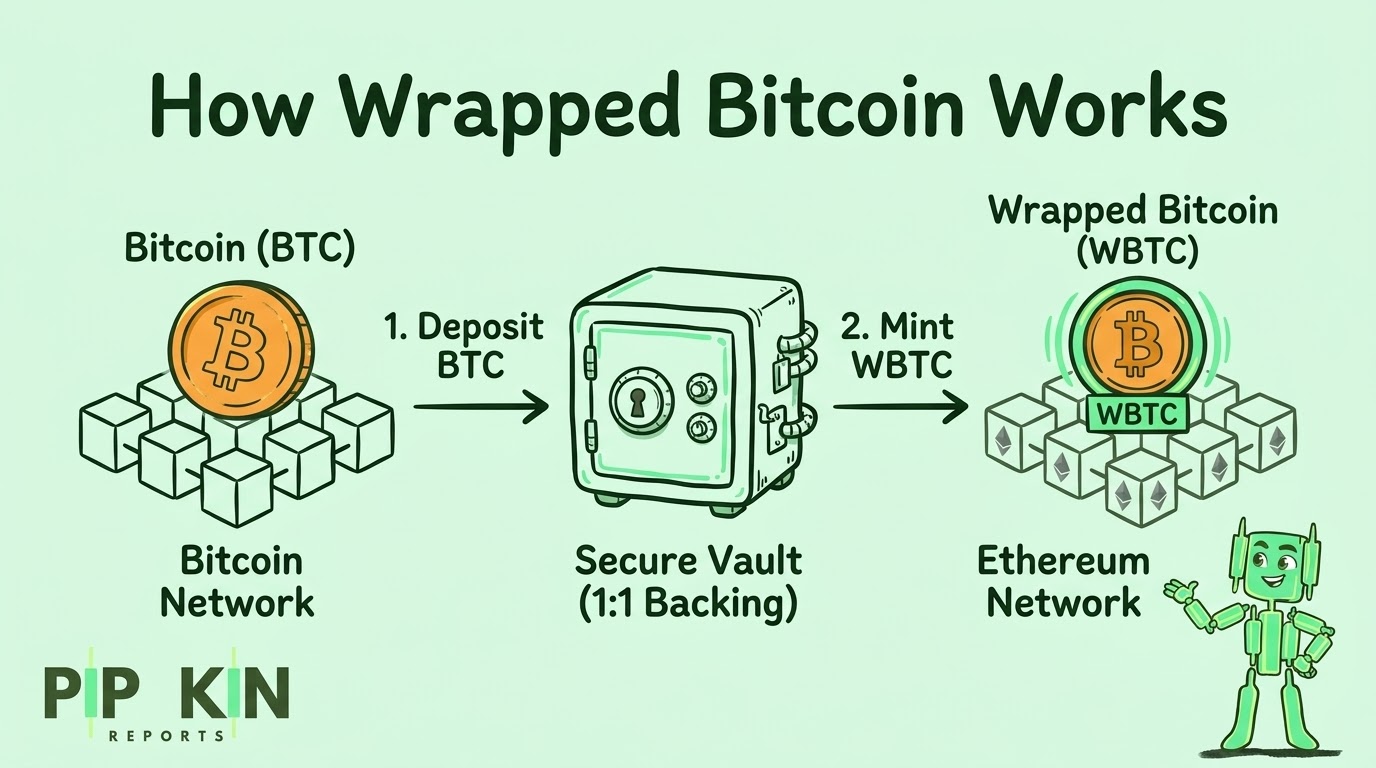
To know the way these tokens operate we will have to take it step by step.
Minting
Minting is the process of creating new wrapped tokens. A user who desires a wrapped crypto coin submits their original coin to a trusted party known as a custodian. This custodian subsequently issues, or mints, the same number of wrapped tokens on the target blockchain.
As an example, when you transfer 1 Bitcoin to the custodian, you will receive 1 WBTC on Ethereum. The supply always matches.
Custodian
The custodian is a sort of safe deposit box. It may be a centralized exchange, a decentralized protocol or even a smart contract. It stores the original coin in a locked and secure position as the wrapped one is being used. The wrapped crypto would be worthless without the custodian, since it is the backing coin that makes it valuable.
Burning
The reverse of minting is burning. When a user wishes to get their original coin back, they send their wrapped tokens to the custodian. The wrapped coins are then destroyed, or rather burned, by the custodian. After the wrapped token is lost, the custodian returns the original coin to the user.
Redeeming
Redeeming simply refers to the process of claiming the initial asset. It makes sure that the wrapped tokens are never out of connection with real coins.
Governance
Decentralized governance is used in some wrapped token systems. This implies that the rules governing the process, including how to mint, burn, and run it are voted upon by groups of token holders. It eliminates isolated control points and enables greater confidence in the system.
In this way, the process of minting, burning, redeeming, and governing the tokens helps keep wrapped tokens trustworthy.
Benefits of Wrapped Tokens
Wrapped tokens have a number of benefits that make them applicable in various blockchains.
- First of all, they permit cross-chain usage. Because blockchains are typically independent, wrapped crypto serves as a bridge. As an illustration, a Bitcoin owner can enter the world of Ethereum-based decentralized finance (DeFi) through WBTC. By doing this, an asset has been allowed to tap into another ecosystem.
- Wrapped tokens also enhance liquidity. Liquidity is the ease with which an asset can be bought and sold. Wrapping tokens allow assets in one chain to migrate to the markets of another. This leads to an increase in trading and the strengthening of markets.
- Access to DeFi is another advantage. There are numerous DeFi platforms that run primarily on Ethereum. Coins of other blockchains can also enter this space with wrapped tokens. This means that the users no longer remain confined to their home chains, and they can have broader opportunities.
- Another benefit is the speed of transactions. There are wrapped tokens that operate on faster and less expensive blockchains than the underlying networks. This assists users in saving time and costs, thus making transactions easier.
Thus, wrapped tokens provide access to previously closed doors, allowing assets to be more flexible and reachable.
Limitations and Risks of Wrapped Tokens
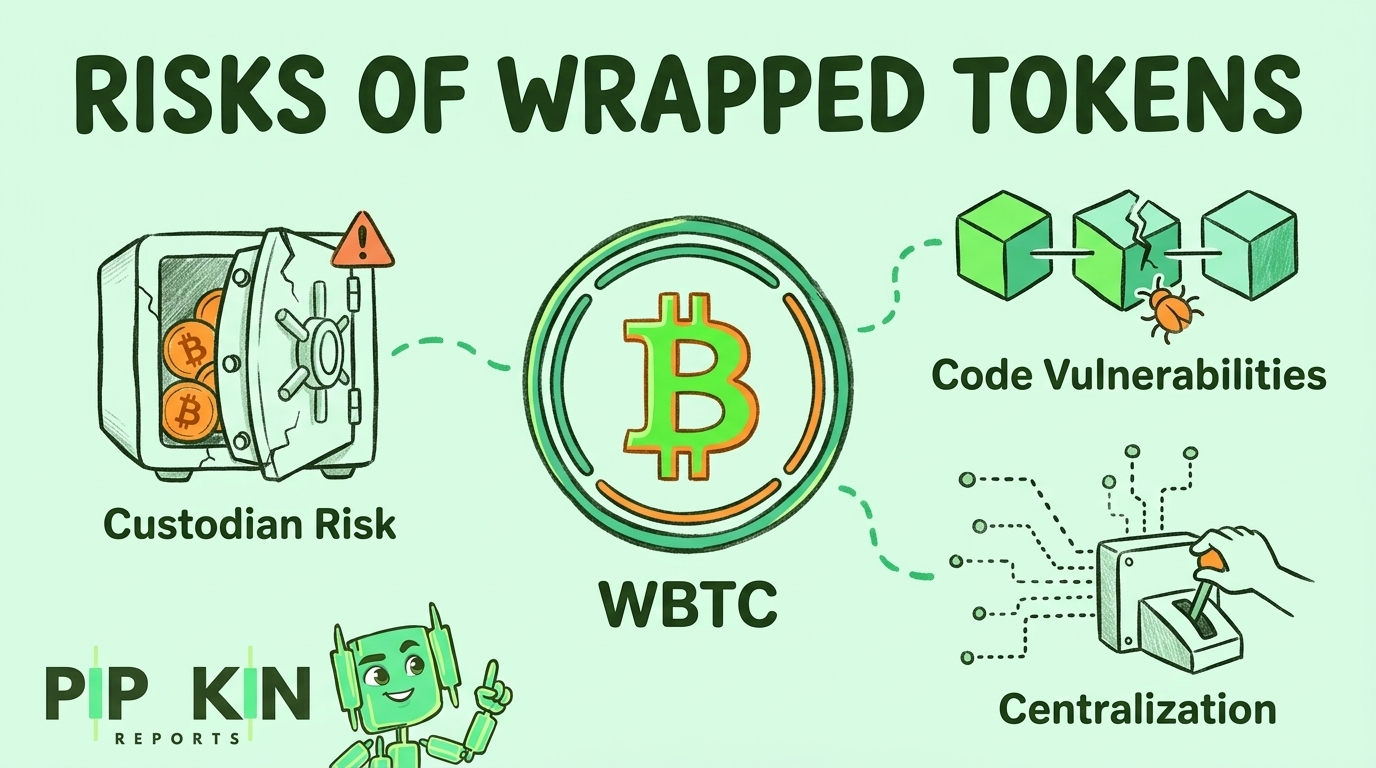
Nevertheless, these tokens are not without some challenges. They are also associated with risks that should be taken into account.
- Custodian risk is one of the issues. Because the original coins are in the custody of the custodians, it requires trust. In the event of failure or hacking of the custodian, the wrapped tokens may lose their value.
- Centralization is another problem. There are wrapped tokens where one or a few central parties manage them. This decreases the decentralized ethos, which blockchains are constructed on.
- Complexity is also an issue of wrapped tokens. What is wrapped may seem simple at first, but tokens wrapping requires additional actions, which are confusing to newcomers. The process can be overwhelming to new users as opposed to being simple.
- Lastly, there is the issue of a lack of support. Wrapped tokens are not available on every blockchain, so their opportunities remain limited.
Therefore, excellent opportunities are generated with the use of these tokens, but the responsibility and risks cannot be overlooked.
Wrapped Tokens Vs Native Tokens
The distinction between native tokens and wrapped tokens is worth noting clearly, as most individuals mix up the two.
The original coin of a blockchain is its native token. For example, Bitcoin is a part of the Bitcoin blockchain, and Ether is a part of Ethereum. These are tokens that are equivalent to a domestic currency of a country. The currency of the United States is the dollars, and the currency of Japan is the yen. Similarly, you cannot spend yen directly in a New York shop. First you would have to exchange it.
Wrapped tokens, on the other hand, have a different mechanism. They do not exist as the original money, yet they are of the same value. A good comparison is a prepaid card or a traveler check. You can bring it overseas and enjoy it more freely, since it is built to operate in a lot of locations.
Wrapped Bitcoin (WBTC) operates in a similar manner in the blockchain world. It is not real Bitcoin on its own blockchain. Rather, it is an Ethereum-based version of Bitcoin. This allows you to use it in the DeFi protocols of Ethereum, although Bitcoin blockchain will not support that.
Hence, the distinction is evident. Original tokens are native and cannot be transferred to another blockchain. Wrapped tokens, however, are replicas that mirror those originals but can exist on different blockchains.
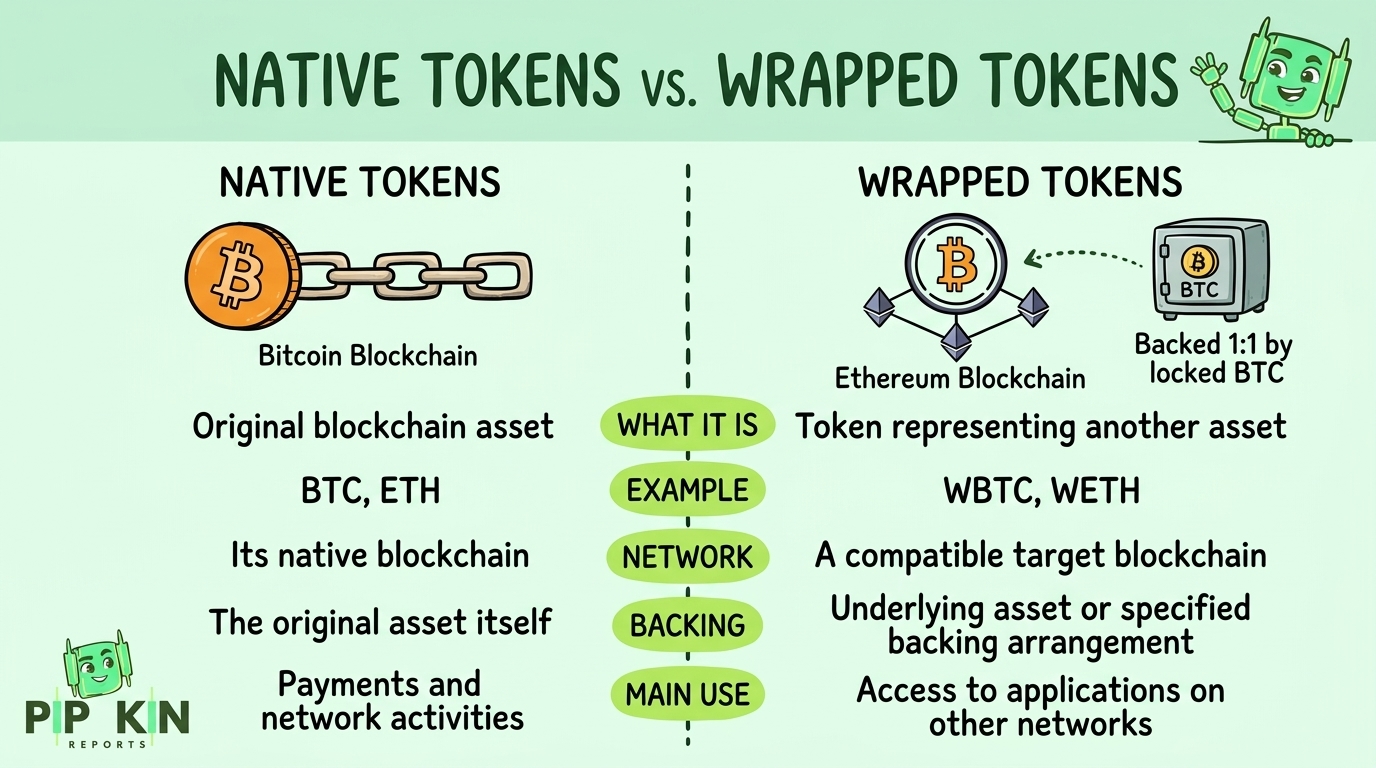
Comparison of Native Vs Wrapped Tokens
| Point | Native Tokens | Wrapped Tokens |
| What they are | The original coins of a blockchain. | Copies of those coins are made to work on another blockchain. |
| Examples | Bitcoin (BTC), Ether (ETH). | Wrapped Bitcoin (WBTC), Wrapped Ether (WETH). |
| Where they work | Only on their own blockchain. | Can move across different blockchains. |
| Flexibility | Limited to one system. | Can be used in many systems. |
| Liquidity | Trading only in the home network. | Adds more trading options in other networks. |
| Control | Managed only by the blockchain rules. | Needs custodians or smart contracts to keep balance. |
| Risks | Risks only from the home chain. | Extra risks like custodian mistakes or contract errors. |
| Analogy | Like a country’s local money. | Like a gift card or traveler’s check you can use it in more places. |
Examples of Wrapped Tokens in 2026
In 2026, many wrapped tokens in crypto exist.
- Wrapped Bitcoin (WBTC): Ethereum Bitcoin.
- Wrapped Ether (WETH): Ether to a typical ERC-20 token.
- Wrapped Flare Tokens: Many people ask, how to wrap Flare tokens? Flare is cross-chain compatible. Wrapping assists them to be linked to other blockchains.
- Wrapped stablecoins: Stablecoins are also wrapped to be used on many different networks.
Those are the examples that wrapping tokens is no longer a rare thing. It has become a regularity of the crypto world.
What is the Importance of Wrapped Tokens?
Wrapped tokens are not only a technical tool. They address real-life problems in the blockchain world. To give an example, we will use a different picture. Think of every blockchain as an independent island. Every island possesses its currency, its regulations, and its markets. You cannot easily trade with another island, when you remain on one island. You would have to cross over and exchange your money every single time.
These tokens are represented as an international passport or universal card that functions on the island. You can move without restriction, you can spend your resources anywhere you want, and you can enter into various marketplaces without making repeated transactions.
The following are the key reasons why wrapped tokens are essential:
- Cross-chain trading: Trading between chains is slow and expensive without wrapping it. Using wrapped crypto, you can trade fast between blockchains. This makes markets smooth.
- Liquidity provision: Financial systems thrive on liquidity. Wrapped tokens introduce additional assets to liquidity pools. This increases the ease of trading and stabilization of prices.
- DeFi applications: Most DeFi runs on Ethereum. Bitcoin holders would not be able to participate in these systems without wrapped tokens. They may lend, borrow or even farm yields with wrapped tokens. This increases opportunity.
- NFT interoperability: Non-fungible tokens are commonly bound to a single blockchain. The wrapping tokens allow linking NFTs across ecosystems, thereby enabling them to be traded or utilized more broadly.
- Cross-chain payments: Think of transferring money between islands without an intermediary bank. This is made possible by wrapped tokens. They assist in making payments across chains directly.
Thus, what are wrapped tokens in crypto is more than a technical explanation. They are one of the tools that enable blockchains to cooperate rather than remain isolated.
Are Wrapped Tokens Safe?
The question many often ask is, are wrapped crypto safe? The response is that they are usually secure in the hands of trusted custodians and safe procedures. Nevertheless, risks still exist.
For example, in case a custodian mismanages money, the wrapped tokens can lose their support. Moreover, smart contract bugs may also introduce vulnerabilities. That is why safety is connected with the person who is in charge of the process and the way the system is constructed.
Therefore, although wrapped crypto is potentially secure, they should never be trusted by users without prior research.
Conclusion
In conclusion, wrapped tokens explained are digital representations of existing cryptocurrencies, which are intended to be interoperable with a variety of blockchains. They are minted and supported by custodians. The tokens can be reclaimed and burned to remain in balance with their original coins.
They have numerous advantages, including cross-chain application, liquidity, and DeFi access. However, they also have risks, including custodian failure and centralization.
In short, what is wrapped can be compared to bridges that link individual islands of blockchain. They do not substitute native tokens, but they enable broader application. Wrapped crypto coins will keep being of central interest as the sphere of the blockchain is expanding, as they enhance access and enable a more connected financial world.