Every system that provides a service comes with a cost. When you order food, the restaurant charges you not only for the ingredients but also for the preparation, packaging, and delivery. Hence, the fee is the price of the effort that goes into making the service possible.
Ethereum works in a similar way. When you use its blockchain to send ETH, interact with DeFi platforms, or mint NFTs, there is work happening behind the scenes. Thousands of computers around the world process your request, check its validity, and add it to the blockchain. This requires energy, hardware, and time. Consequently, the fee you pay for this effort is called a gas fee.
Gas fees are one of the most important parts of Ethereum’s design. They make the system secure, efficient, and fair. Without gas, Ethereum would not be able to function as a global platform for decentralized applications. Therefore, understanding Ethereum gas fees is essential for anyone who wants to use Ethereum in a smart and informed way.
What is Ethereum Gas Fees?
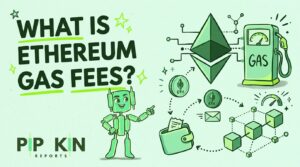
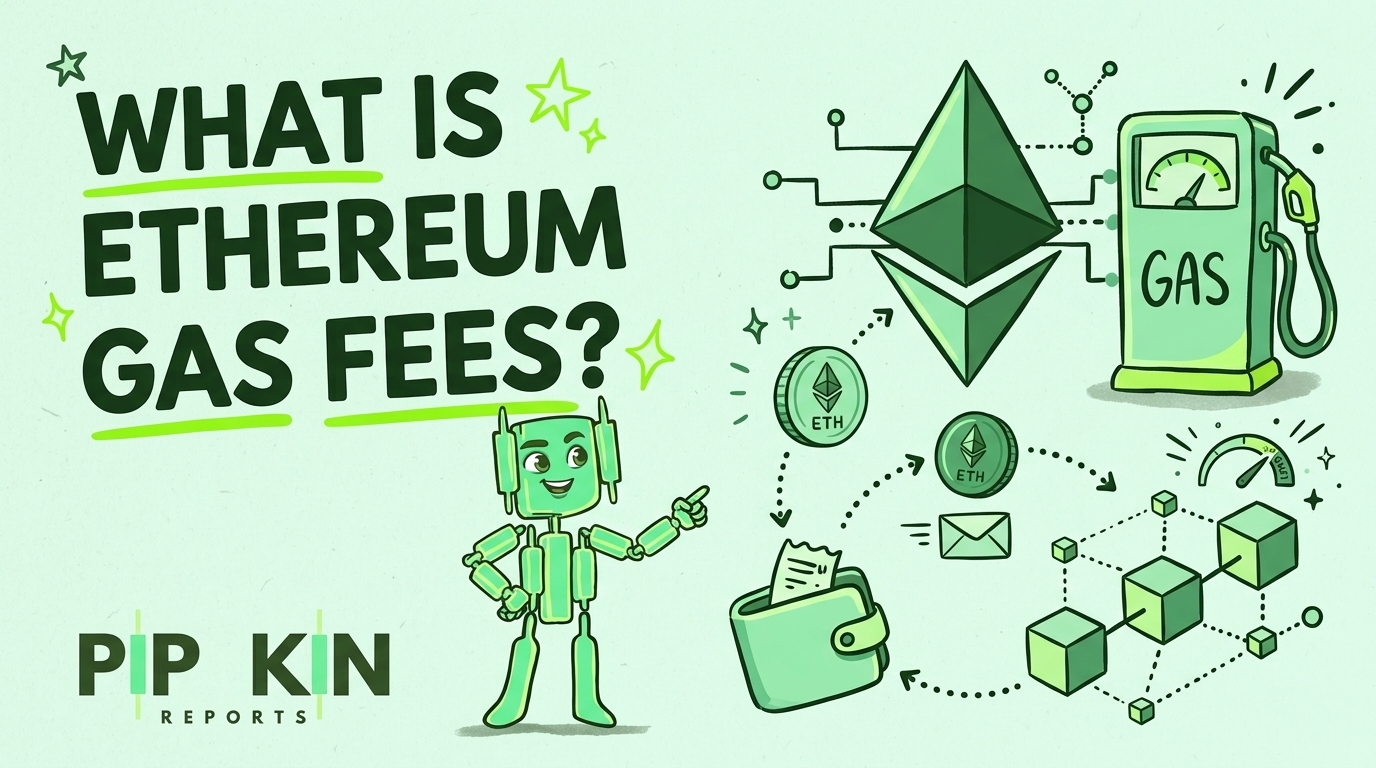
To define, Ethereum gas fee is a measure of how much computational power is needed to perform an action. It works like fuel. Just as a car needs fuel/gas to move, Ethereum needs gas to process transactions and run smart contracts. However, remember that gas is not exactly the same as a simple transaction fee.
For example, in banking, you might pay a flat fee no matter if you transfer ten dollars or a thousand. Just like that, but Ethereum is more precise. Here, the amount of gas depends on how complex the transaction is.
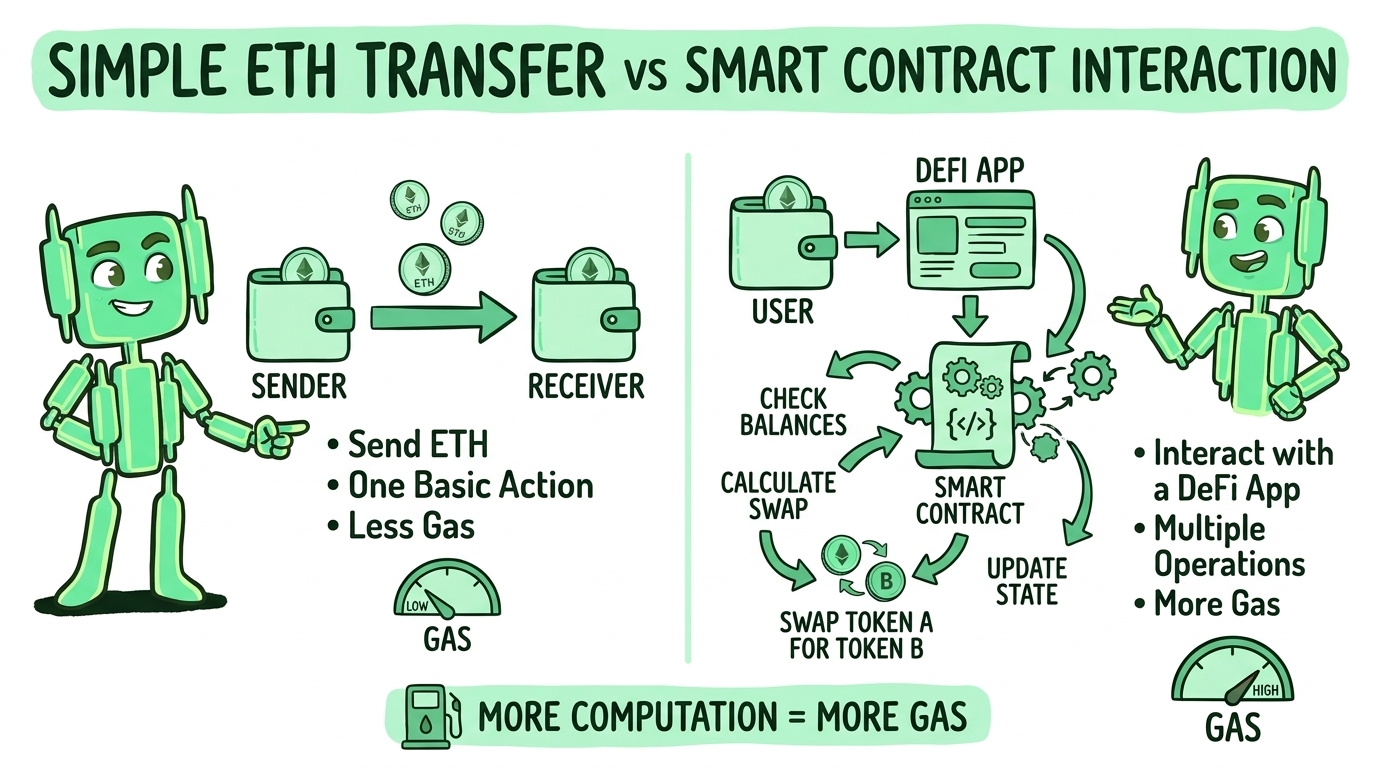
Sending ETH from one wallet to another uses very little gas, whereas, deploying a large smart contract consumes much more. Therefore, this system makes payments fair because users only pay ETH transaction fee for the actual resources they use.
Gas fees are always paid in ETH, regardless of whether you are sending ETH or another token. This means you need to keep extra ETH in your wallet for gas purposes.
How do Ethereum Gas Fees Work?
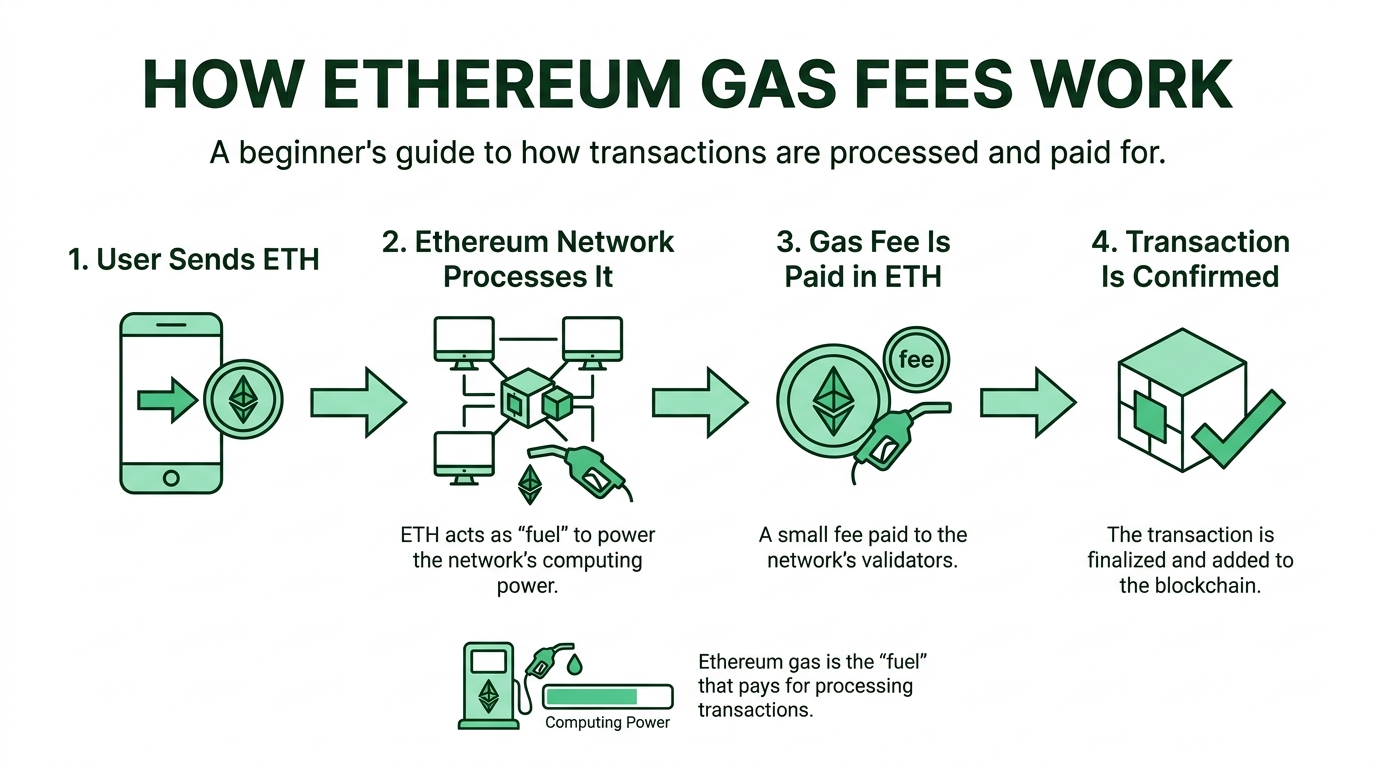
Gas is primary to Ethereum’s daily operation. Every single transaction, no matter large or small, consumes gas because it requires the Ethereum Virtual Machine, or EVM, to perform work. The EVM executes all smart contracts and calculations on the network. Each operation in the EVM, such as storing data or performing arithmetic, has an Ethereum gas cost.
Hence, this setup makes Ethereum reliable. It is because, developers know in advance how much their programs will cost to run, and users know they are paying for real work being done.
At the same time, gas prevents abuse. If transactions were free, someone could overload the system with endless requests. This could ultimately slow down the overall network for everyone else.
Therefore, by attaching a cost, Ethereum filters out spam and keeps resources for meaningful actions.
When people ask what is gas in crypto, they mean the payment a user makes for their transaction to be processed.
How to Calculate ETH Gas Fee?
Interestingly, crypto gas fees are not random. They depend on two main factors: the gas price and the gas limit. Gas price is how much you are willing to pay for each unit of gas. It is usually measured in gwei, a small fraction of ETH. Meanwhile, gas limit is how much gas you allow your transaction to use.
If the limit is set too low, the transaction may fail because it runs out of gas before finishing. On the other hand, if it is set higher than needed, you only pay for the portion that is used and the rest is refunded. Usually, wallets often suggest default limits for simple transfers, while more complex transactions may require higher amounts.
Like every other thing, gas also has its own denominations.
- The smallest unit is wei.
- One billion wei equals one gwei.
- And one billion gwei equals one ETH.
This system allows precise calculation of fees even when they are very small.
The formula for Ethereum gas fees is very simple: Gas Fee = Gas Units × Gas Price
For example, a standard ETH transfer requires 21,000 gas units. If the gas price is set at 1 gwei, then the total cost is 21,000 × 1 = 21,000 gwei. Converting this back gives 0.000021 ETH. If ETH is trading at 2,000 dollars, the fee comes to around 4 cents.
This example shows two things.
- First, gas usage depends on how difficult the transaction is. A simple transfer always takes around 21,000 units. Whereas, interacting with a DeFi protocol may take several hundred thousand.
- Second, the cost in dollars depends not only on gas usage but also on the market price of ETH.
It means, when ETH rises in value, the same amount of gas becomes more expensive for users.
Who Gets the Gas Fees?
Gas fees do not disappear. Rather, the fee goes to the users and systems that keep Ethereum network running. Previously, before Ethereum’s Merge in 2022, miners used to receive gas fees. Their function was to use energy-intensive computers to secure the network and add new blocks.
However, after the Merge, Ethereum switched to Proof of Stake, and then validators took their place. Now, validators stake ETH and confirm the transactions. In return, they receive the ethereum gas fees as a reward for their service.
Furthermore, since the London upgrade known as EIP-1559, fees are divided into two parts. The base fee is burned, meaning it is permanently removed from circulation. And, the priority fee or tip goes directly to the validator. While the burning fees reduces the overall ETH supply, the tips motivate validators to process transactions faster. Interestingly, the legacy transactions before EIP-1559 are called as Type 0, while newer ones are known as Type 2.
Let us look at it in a different way.
| Time / Upgrade | Who Receives the Fees? | How Fees Are Handled |
| Before the Merge (Pre September-2022) | Miners | Miners used energy-intensive computers to secure the network and earned gas fees. |
| After the Merge (Proof of Stake) | Validators | Validators stake ETH, confirm transactions, and receive gas fees as rewards. |
| Since London Upgrade (EIP-1559) | Split System | Base fee is burned (removed from supply). Priority fee (tip) goes to validators. |
| Transaction Types | Type 0 (Legacy) & Type 2 (Post EIP-1559) | Legacy Type 0 used before EIP-1559. Type 2 transactions follow the new fee structure. |
Why Does Ethereum Gas Fees Varies?
Meanwhile, Gas is not just a technical measure. It also plays a key role in Ethereum’s economy.
- For developers, gas fees are a constant consideration when writing smart contracts. Inefficient code can make a project expensive for users, which may discourage adoption.
- For investors, gas fees influence whether Ethereum remains attractive compared to cheaper blockchains.
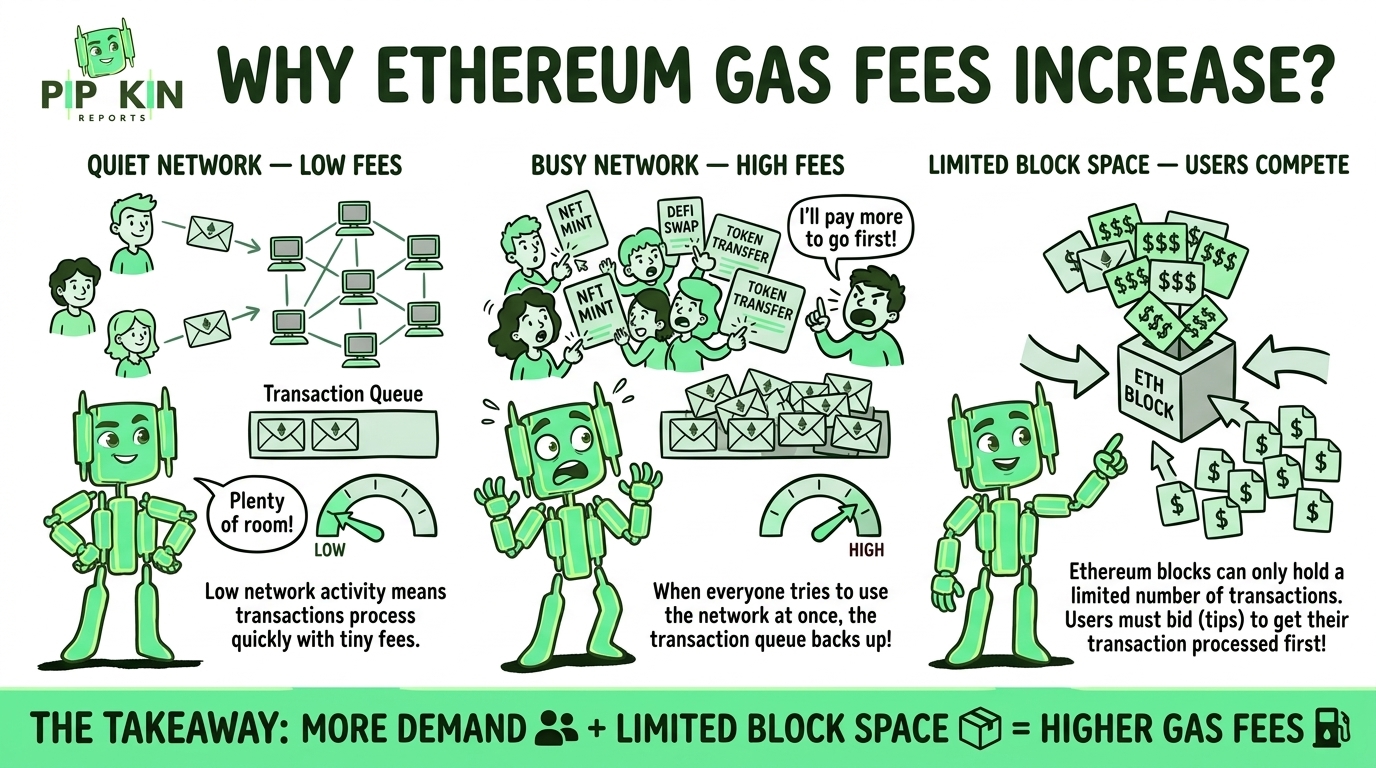
- There are several factors that affect gas fees. Among them, network congestion is the most important one. To explain, if many people try to transact at the same time, the limited block space automatically becomes valuable, and users try to bid higher to get included quickly.
- At the same time, transaction type also matters. It means, simple transfers cost less, whereas, smart contracts or decentralized applications can be much more costly.
- Finally, the block size itself is limited, so fees rise naturally when demand exceeds supply.
What Makes Ethereum Gas Fees So Unpredictable?
From a portfolio perspective, gas fees can even affect decision making of a user. In simple terms, traders might delay an action if fees are high, or they may choose another blockchain for smaller transactions. Consequently, gas costs ripple through both the technical and financial layers of Ethereum.
Ethereum gas fees are famously unpredictable. During calm periods, they may be just a few cents. But when excitement builds, such as during a popular NFT mint or a sudden market sell-off, fees have jumped to tens or even hundreds of dollars.
The reason is simple: block space is limited. When demand spikes, users compete to have their transactions processed, and they increase their gas price offers to outbid others. Validators naturally include higher-paying transactions first, which drives fees upward.
| Factor | Impact on Gas Fees | Example Scenario |
| User Decisions | Traders delay transactions or move to cheaper blockchains when fees are high. | Choosing another chain for small transfers. |
| Calm Periods | Fees remain low, often just a few cents. | Normal weekday activity with fewer transactions. |
| High Demand Events | Fees rise sharply, sometimes to tens or hundreds of dollars. | NFT mint launches or sudden market sell-offs. |
| Record Spikes | Highest gas fee Ethereum users ever paid happened during extreme congestion. | Heavy traffic periods with too many pending transactions. |
| Block Space Limits | Limited capacity forces users to compete with higher gas bids. | Validators prioritize higher-paying transactions first. |
How to Reduce Ethereum Gas Fees
Even though gas fees cannot be avoided completely, they can be reduced. Let us look at some common ways to reduce Ethereum gas fees.
1- Choose the right timing
Gas fees rise when the network is crowded. Meanwhile, they drop when fewer people are active. Hence, sending transactions at night or on weekends often costs much less.
2- Use Layer 2 solutions
Layer 2 networks handle work off the main chain. They then send results back to Ethereum. Therefore, transactions become faster and cheaper while still staying secure.
3- Batch multiple actions
Instead of paying a fee for each action, you can combine them. Hence, one transaction can replace many and save money over time.
How to Optimize Ethereum Gas Usage
Gas fees are not only about paying less but also about using them wisely. Therefore, let us look at some simple methods to optimize Ethereum gas usage.
1- Rely on efficient smart contracts
Some apps use contracts that consume less gas. Therefore, interacting with them feels lighter on the wallet.
2- Adjust gas settings wisely
Wallets let you pick gas price and limit. If you set them too low, the transaction may fail. Meanwhile, setting them too high leads to overpayment. Therefore, choosing carefully helps avoid waste.
3- See transactions as bids
Every transaction on Ethereum works like a bid. By offering more, you move ahead in the line. By offering less, you wait longer but can save money. Knowing this balance gives users more control over costs.
4- Use wallet presets
Most wallets show simple options like slow, average, or fast. Choosing slow saves money but takes more time, while fast costs more but confirms quickly. Hence, presets make it easy to balance speed and cost without manual settings.
5- Pair strategies together
Each method works on its own, but combining them gives better results. For example, running actions on a Layer 2, batching them, and picking quiet hours together brings the biggest cut in fees without sacrificing Ethereum’s security.
What Are Out of Gas Errors?
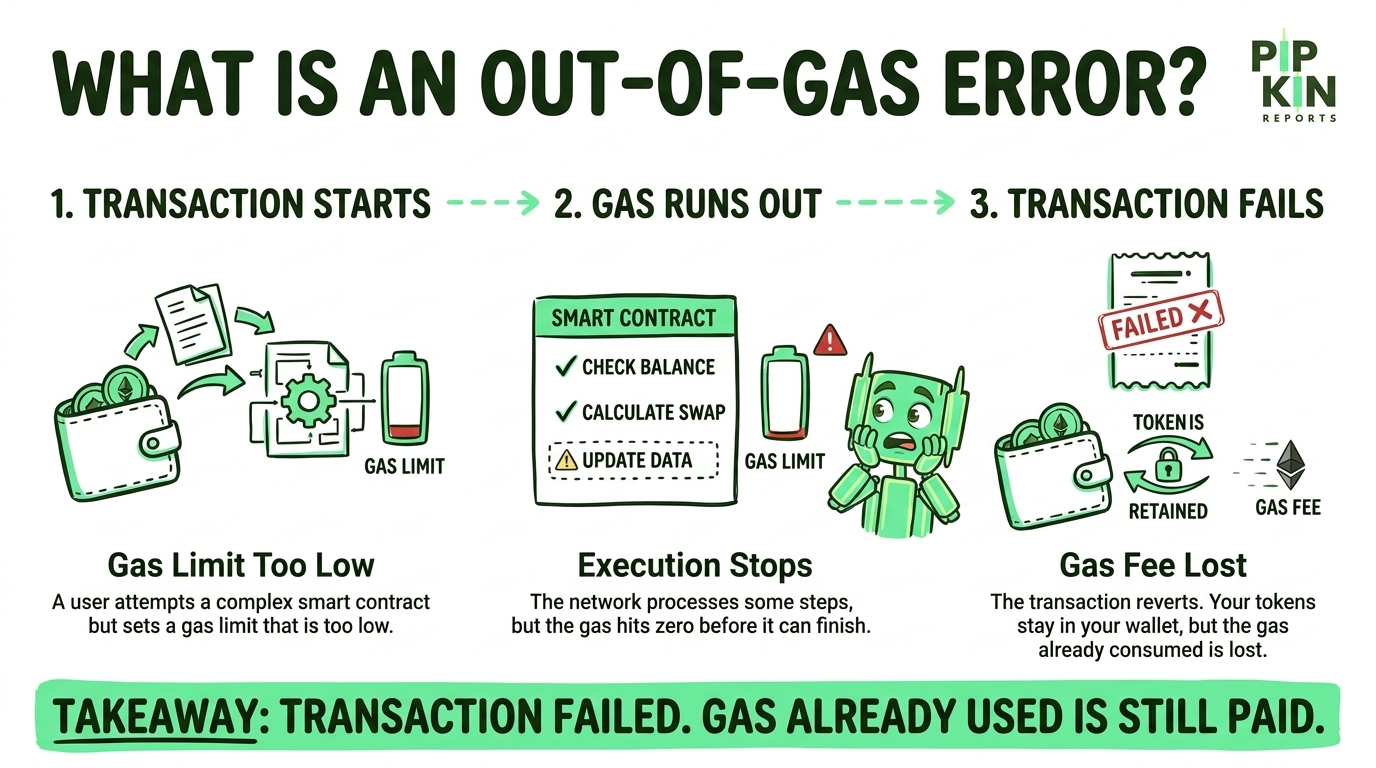
Sometimes transactions fail with an “out of gas” error. This happens when the gas limit is set lower than what is required. Therefore, the transaction does not finish, but some gas is still used because the validator already did part of the work. The ETH or tokens you wanted to send stay in your wallet, but the gas you spent is lost.
This issue often comes up when dealing with smart contracts, since they usually need more than the basic 21,000 units. Wallets usually suggest a suitable gas limit. However, if you are not sure, checking past transactions of a similar type can help.
Furthermore, it is smart to keep some extra ETH in your wallet so you can handle sudden gas costs.
How is Ethereum Improving Gas Fees?
Ethereum is shifting to a rollup-focused model. The idea is not to remove fees but to make them smaller and easier to manage. Most activity moves to Layer 2 networks, while the main chain works as the secure settlement layer.
- The Dencun upgrade (EIP-4844) brought “blobs,” a new way to handle data. These blobs give Layer 2s cheaper space to store information, which has already cut costs on networks like Optimism and Base.
- The Pectra upgrade, launched in May 2025, added more blobs and improved efficiency. It did not cut fees by itself but gave Layer 2s more room to grow.
- The next step was the Fusaka upgrade, which went live in December 2025. It included PeerDAS, a way for nodes to check blob data faster. Two Blob Parameter Only (BPO) upgrades followed in December 2025 and January 2026. They raised the blob target from 6 to 14 and the blob limit to 21. Fusaka also raised the default gas limit to 60 million. As a result, Layer 2s have even more room to handle rollup transactions.
- The next big upgrade is Glamsterdam, which aims to raise the gas limit up to 200 million. It was first planned for June 2026, but it was pushed back to the fourth quarter. It went live on the Sepolia testnet in October 2026. However, its Hoodi testnet launch was postponed on October 22, because developers are checking how a gas change called EIP-8037 affects existing smart contracts. No mainnet date has been set yet.
- Further ahead is full Danksharding, which is part of what Ethereum’s roadmap calls The Surge. This will split Ethereum into smaller parts that run side by side. As a result, Layer 2s will handle thousands of transactions each second at a much lower cost.
The path is steady. Ethereum aims to keep security and decentralization while making fees low enough for people to use it every day.
Wrapping Up
Gas plays an important role in Ethereum. It powers everything from simple transfers to complex smart contracts. Hence, it makes sure resources are paid for, keeps the system secure, and prevents the network from being filled with unnecessary activity.
Although Ethereum gas fees can sometimes be high and unpredictable, they also show how widely Ethereum is used and valued. For users, the key is to manage gas wisely by watching prices, choosing good times to transact, and exploring Layer 2 solutions. For Ethereum, the challenge is to keep improving the system so that costs fall without losing safety.